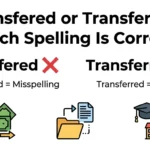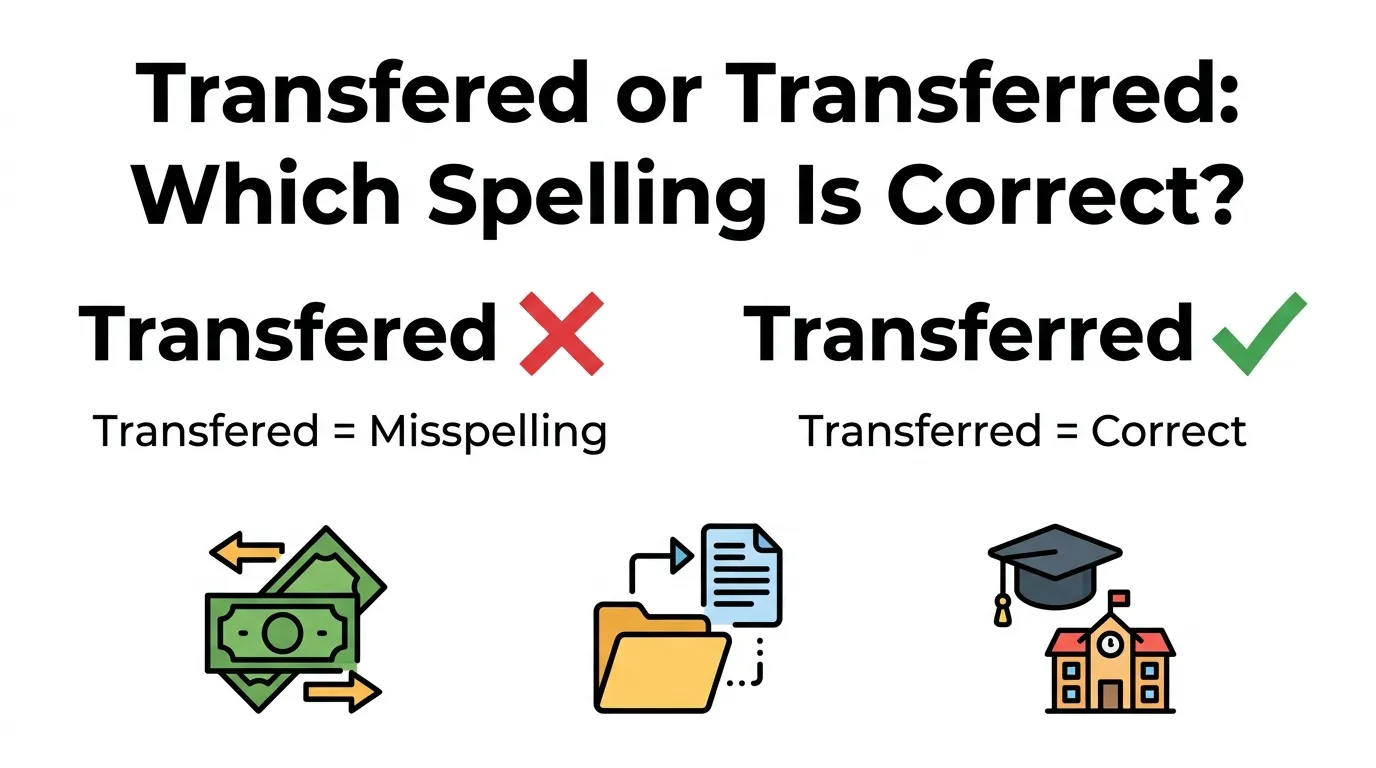
“Transferred” is the correct spelling in English, while “transfered” is a common misspelling because the final r must be doubled before adding -ed. ✍️✅
Have you ever typed transfered and wondered if it should be transferred instead? You are not alone. This is one of the most common spelling mistakes in English because the word follows a rule that many writers forget.
The confusion comes from the verb transfer. When changing it to the past tense or past participle, some people write transfered with one “r,” while others write transferred with two “r’s.” Since English spelling rules can be tricky, many people search for “transfered or transferred” to find the correct form.
The good news is that there is a clear answer. One spelling is correct in both British and American English, while the other is considered a spelling mistake.
In this guide, you’ll learn the correct spelling, why the extra “r” is needed, how the word developed, common mistakes to avoid, real-world examples, and professional writing tips. By the end, you’ll know exactly which spelling to use in emails, reports, academic work, and everyday communication.
Transfered or Transferred :Quick Answer
Transferred is the correct spelling.
Transfered is incorrect.
Examples
✅ Correct: “The money was transferred to another account.”
✅ Correct: “She transferred to a new school.”
❌ Incorrect: “The money was transfered.”
Always use transferred with two “r’s.”
The Origin of Transfered or Transferred
The word transfer comes from Latin and entered English through French.
In English, when a verb ends with a stressed vowel followed by a consonant, the final consonant is often doubled before adding -ed.
Because the stress falls on the final syllable of transfer (trans-FER), the letter r is doubled.
This creates transferred.
The same rule applies to words such as:
- Refer → Referred
- Prefer → Preferred
- Infer → Inferred
British English vs American English Spelling
Unlike some English words, there is no spelling difference here.
Both British and American English use transferred.
Comparison Table
| British English | American English |
| Transferred | Transferred |
| Transfered ❌ | Transfered ❌ |
Examples
UK: “The employee was transferred to London.”
US: “The employee was transferred to Chicago.”
The spelling remains the same in both regions.
Which Spelling Should You Use?
For US Audiences
Use transferred.
For UK Audiences
Use transferred.
For Australia, Canada, and Commonwealth Countries
Use transferred.
For Global Audiences
Always choose transferred because it is the only correct spelling.
Common Mistakes with Transfered or Transferred
Many writers make these mistakes:
| Incorrect | Correct |
| Transfered | Transferred |
| Money transfered | Money transferred |
| Student transfered | Student transferred |
| Data transfered | Data transferred |
Incorrect
“The funds were transfered yesterday.”
Correct
“The funds were transferred yesterday.”
Incorrect
“He transfered to another department.”
Correct
“He transferred to another department.”
Transfered or Transferred in Everyday Examples
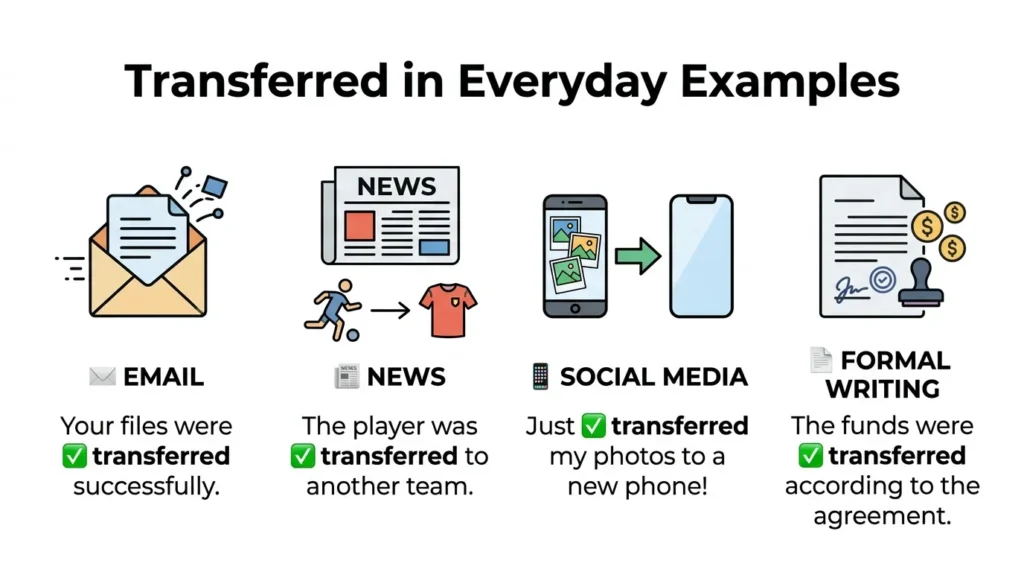
“Your files have been transferred successfully.”
News
“The player was transferred to another team.”
Social Media
“Finally transferred all my photos to a new phone!”
Formal Writing
“The assets were transferred according to the agreement.”
Transfered or Transferred : Google Trends & Usage Data
Search and usage data show that transferred is overwhelmingly more popular than transfered.
Why People Search This Keyword
- They forget the double-letter rule.
- Spell-check tools highlight the word.
- They want accurate business writing.
- They are learning English grammar.
Popularity Comparison
| Word | Popularity |
| Transferred | Very High |
| Transfered | Very Low |
Most searches for transfered come from spelling verification.
Comparison Table
| Feature | Transferred | Transfered |
| Correct English | Yes | |
| No | ||
| Dictionary Approved | Yes | No |
| Professional Writing | Yes | No |
| Academic Writing | Yes | No |
| Recommended Usage | Yes | No |
FAQs
1. Is transfered or transferred correct?
Transferred is correct.
2. Why does transferred have two r’s?
Because the stress falls on the last syllable of transfer, the final consonant is doubled before adding -ed.
3. Is transfered a real word?
No. It is considered a spelling mistake.
4. Do British and American English spell it differently?
No. Both use transferred.
5. How do I remember the correct spelling?
Think of similar words such as preferred, referred, and inferred, which also double the final letter.
6. What is the present tense form?
The present tense form is transfer.
7. Is transferred used in business writing?
Yes. It is the standard spelling in professional communication.
Conclusion
When comparing transfered or transferred, the correct choice is simple: transferred. The spelling requires two “r’s” because English spelling rules double the final consonant when a stressed syllable is followed by -ed. This is the same pattern seen in words such as preferred, referred, and inferred.
The spelling transfered is a common mistake and should be avoided in professional, academic, and everyday writing.If you are discussing money transfers, employee transfers, school transfers, or data transfers, transferred is always the correct form.
This rule applies in British English, American English, Canadian English, and other major forms of English. No regional spelling difference exists.
If you are ever unsure, remember this simple rule: transfer → transferred. Using the correct spelling will make your writing clearer, more professional, and grammatically correct.
Read more about!
Cancellations or Cancelation: Which Spelling Is Correct?
Fiber or Fibre: Which Spelling Is Correct?
Die or Dice: Which Word Is Correct?

I am an English author who loves words and their meaning. Writing is not just my work, it is my passion. I write to make English simple, clear, and easy to understand for everyone. My focus is on real language, real mistakes, and real learning. Every article I write comes from research, experience, and a love for honest writing. My goal is simple: help readers feel confident with English.