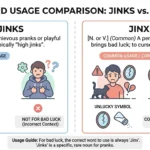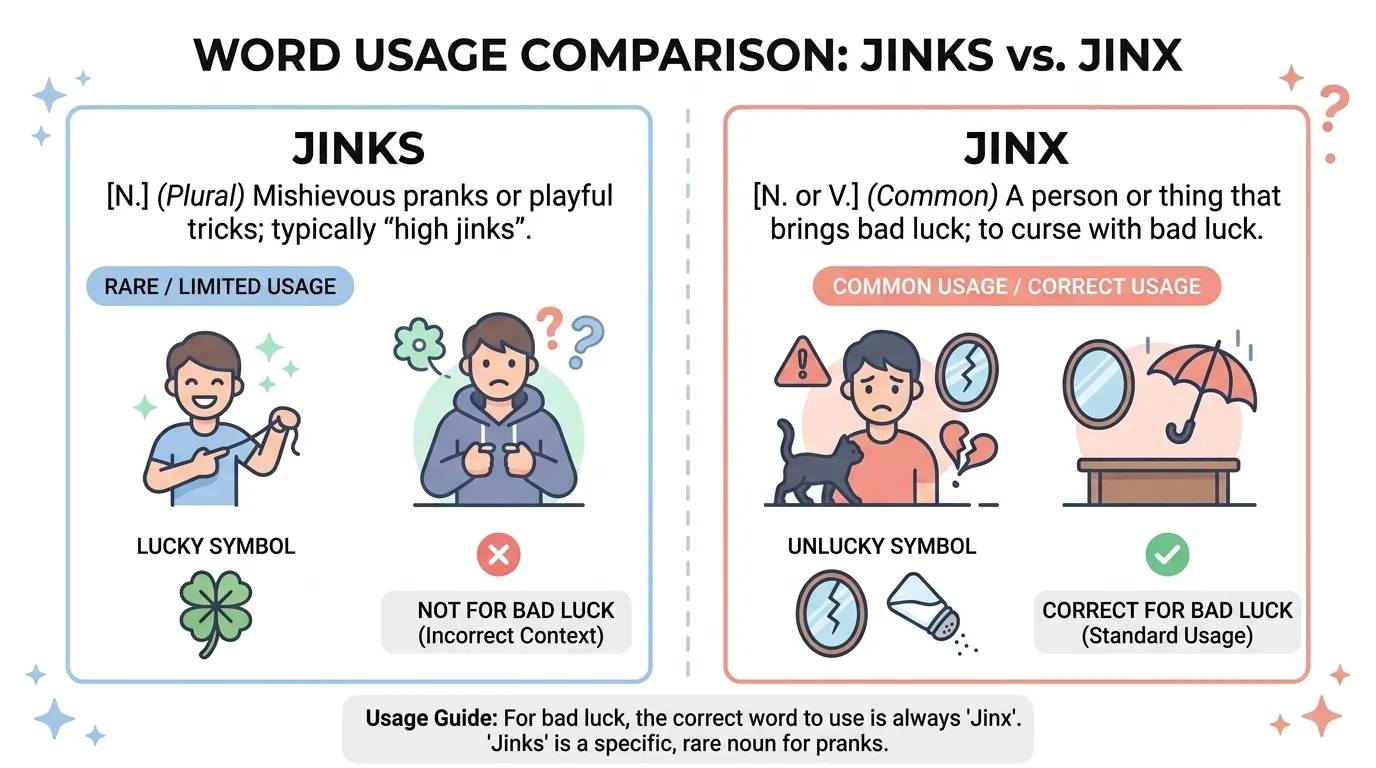
Jinx is the correct and common word for bad luck, while “jinks” is rare and used differently.
Many people search for “jinks or jinx” because the two words sound very similar. The confusion often happens in conversations, games, sports, and social media posts. Some people write “jinks” when they actually mean “jinx,” while others wonder if both spellings are correct.
The word “jinx” is much more common in modern English. It usually means bad luck or something believed to bring bad luck. “Jinks,” on the other hand, is a less common word and is mainly used in older English or special situations like aviation or sudden quick movements.
Because both words sound alike, many writers and speakers mix them up. This article explains the meaning, history, spelling differences, and correct usage of “jinks” and “jinx” in simple language. You will also learn how these words appear in everyday communication, online searches, and professional writing.
If you are writing a message, school paper, blog post, or social media caption, this guide will help you choose the correct word with confidence.
Jinks or Jinx : Quick Answer
Jinx is the correct and most common word when talking about bad luck or superstition.
“Jinks” is rare and usually refers to tricky movements or old-fashioned expressions.
Simple Examples
| Word | Meaning | Example |
| Jinx | Bad luck | “Don’t jinx the game!” |
| Jinks | Quick movements | “The pilot made sharp jinks.” |
Quick Tip
If you mean bad luck, always use jinx.
The Origin of Jinks or Jinx
Jinx
The word Jinx became popular in the late 1800s. It likely came from the name “Jynx,” a magical bird in Greek mythology connected with spells and bad luck.
Over time, “jinx” became a common English word meaning:
- A person who brings bad luck
- A situation believed to cause failure
- A superstition
Jinks
The word “jinks” is older and less common today. It was used to describe sudden twisting or dodging movements. It sometimes appears in military or aviation writing.
Why People Confuse Them
People confuse these words because:
- They sound almost the same
- “Jinx” is often spoken quickly
- Spell-check tools sometimes miss the mistake
British English vs American English Spelling
Both British and American English mainly use the spelling “jinx.”
“Jinks” is uncommon in both regions.
| American English | British English |
| Jinx | Jinx |
| Bad luck | Bad luck |
| Don’t jinx it | Don’t jinx it |
Example Sentences
| Region | Example |
| United States | “You jinxed the team!” |
| United Kingdom | “That comment may jinx the match.” |
| Australia | “Don’t jinx our chances.” |
Which Spelling Should You Use?
Use jinx in almost all modern writing and speech.
Audience-Based Advice
| Audience | Recommended Word |
| US readers | Jinx |
| UK readers | Jinx |
| Global audience | Jinx |
Best Practice
Use “jinx” when discussing:
- Bad luck
- Superstitions
- Sports
- Games
- Predictions
Only use “jinks” if discussing quick movements or historical language.
Common Mistakes with Jinks or Jinx
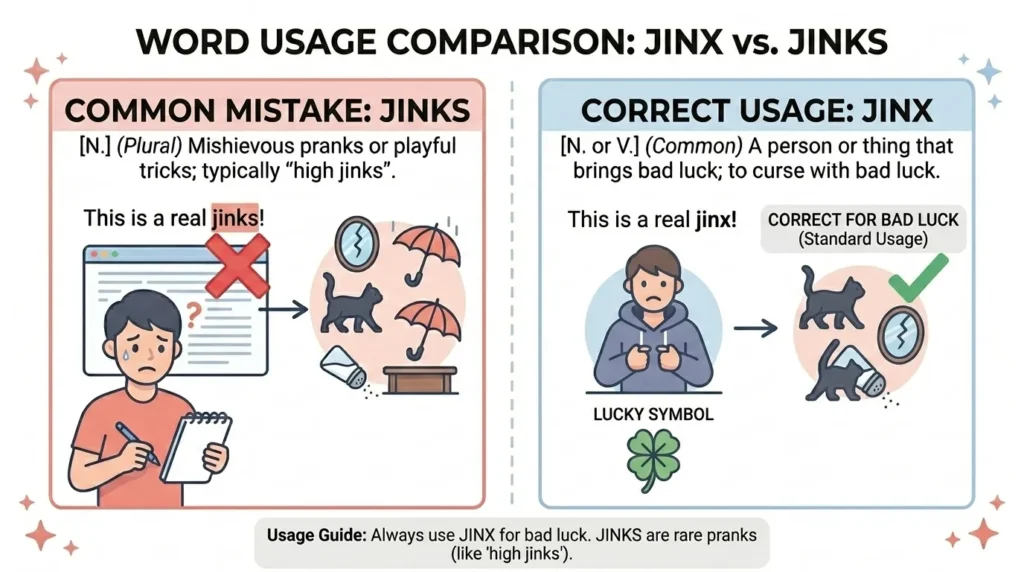
Many people use the wrong spelling because the words sound alike.
| Mistake | Correct Usage |
| “You jinksed it” | “You jinxed it” |
| Using “jinks” for bad luck | Use “jinx” |
| Thinking both words mean the same thing | They have different meanings |
| Writing “jincks” | Correct spelling is “jinx” |
Common Spelling Errors
| Wrong | Correct |
| Jinks | Jinx |
| Jincks | Jinx |
| Jynx | Jinx |
Jinks or Jinx in Everyday Examples
In Emails
“I hope we do not jinx the project before launch.”
In News Articles
“Fans worried the early celebration would jinx the team.”
On Social Media
“Don’t jinx my favorite player before the final match!”
In Formal Writing
“Some athletes avoid certain comments because of superstition and fear of a jinx.”
Jinks or Jinx : Google Trends & Usage Data
Search data shows that Jinx is searched far more often than “jinks.”
Popular Contexts
| Word | Common Searches |
| Jinx | Sports, games, luck |
| Jinks | Aviation, movement terms |
Why People Search This Keyword
People search “jinks or jinx” because they want to know:
- The correct spelling
- The meaning of jinx
- If jinks is a real word
- How to use the words correctly
Jinks vs Jinx Comparison Table
| Feature | Jinks | Jinx |
| Common Today | Rare | Very common |
| Main Meaning | Quick movement | Bad luck |
| Used in Sports | Rarely | Often |
| Used in Conversation | Rarely | Frequently |
| Correct for Superstition | No | Yes |
FAQs
Is it jinks or jinx?
“Jinx” is correct when talking about bad luck or superstition.
Is jinks a real word?
Yes, but it is rare and usually refers to sudden quick movements.
What does jinx mean?
A jinx is something believed to bring bad luck.
Why do people say “don’t jinx it”?
They mean “don’t say something that could cause bad luck.”
Is jinx used in sports?
Yes. Fans often use “jinx” during games and competitions.
Can a person be called a jinx?
Yes. Someone may jokingly call another person a jinx if bad luck follows them.
Which spelling is more common online?
“Jinx” is much more common in books, websites, and social media.
Conclusion
The words “jinks” and Jinx may sound similar, but they have different meanings and uses. In modern English, “jinx” is the correct and widely accepted word when talking about bad luck, superstition, or unlucky situations.
“Jinks” is a real word, but it is rare today and mainly appears in older writing or special topics like aviation and movement. Most people who search for “jinks or jinx” actually want the spelling and meaning of “jinx.”
To avoid confusion, remember this simple rule: if you mean bad luck, use “jinx.” This spelling works in conversations, articles, emails, social media posts, and formal writing.
Learning the difference between these words improves your writing and helps you communicate more clearly. Even small spelling choices can change meaning, so using the correct word matters.
Read more about!
Apple or Samsung: Which Smartphone Brand Is Better for You?
Temu or Shein: Which Is Better?

Hye ! I am Henry P. Whitmore i am English writer known for my clear and practical approach to English grammar, word usage, and language clarity. I focuses on helping learners, writers, and professionals understand confusing English terms in a simple way. My work is especially useful for people who struggle with spelling differences, word meanings, and correct usage in everyday writing