Both “fiber” and “fibre” are correct “fiber” is the American English spelling, while “fibre” is used in British English. 🌾✍️
Have you seen the words fiber and fibre and wondered which one is correct? You are not alone. Many people search for “fiber or fibre” because both spellings appear in books, websites, food labels, health articles, and internet service advertisements.
The confusion happens because both words have the same meaning but follow different English spelling systems. In some countries, you will see fiber, while in others, you will see fibre. This can make writing for an international audience difficult.
The good news is that both spellings are correct. The right choice depends on where your audience lives and which version of English you use. Understanding this difference can help you write more professionally and avoid spelling mistakes.
In this guide, you will learn the meaning of fiber and fibre, their history, regional spelling differences, common mistakes, usage examples, and when to use each spelling. By the end, you’ll know exactly which version fits your audience.
Fiber or Fibre : Quick Answer
Both fiber and fibre are correct.
- Fiber is the American English spelling.
- Fibre is the British English spelling.
Examples
- US: “This cereal contains a lot of fiber.”
- UK: “This cereal contains a lot of fibre.”
The meaning stays exactly the same.
The Origin of Fiber or Fibre
The word comes from the Latin word fibra, meaning a thread, strand, or filament.
Over time, the word entered English as fibre. When American English spelling became standardized in the 1800s, many words were simplified. This led to fiber becoming the preferred spelling in the United States.
The spelling difference developed because British and American English evolved separately.
British English vs American English Spelling
The main difference is regional preference.
| British English | American English |
| Fibre | Fiber |
| Centre | Center |
| Theatre | Theater |
| Metre | Meter |
Examples
British English:
“The food is rich in fibre.”
American English:
“The food is rich in fiber.”
Both sentences are correct.
Which Spelling Should You Use?
For US Audiences
Use fiber.
For UK Audiences
Use fibre.
For Australia, New Zealand, Canada, and Commonwealth Countries
Fibre is generally preferred, although some industries may use fiber.
For Global Audiences
Choose one spelling and use it consistently throughout your content.
Common Mistakes with Fiber or Fibre
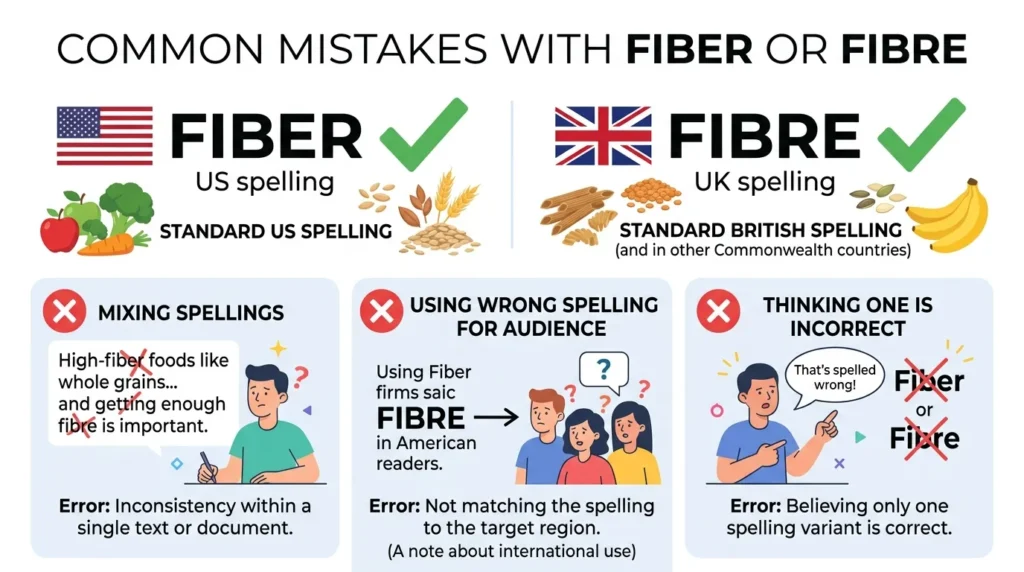
Many writers make these mistakes:
| Mistake | Correction |
| Mixing fiber and fibre in the same article | Use one style consistently |
| Assuming one spelling is wrong | Both are correct |
| Using fibre for US readers | Use fiber |
| Using fiber for UK readers | Use fibre |
Incorrect
“The product contains fiber and fibre.”
Correct
“The product contains fiber.”
or
“The product contains fibre.”
Fiber or Fibre in Everyday Examples
“Our new cereal contains more fiber than previous versions.”
News
“Experts recommend increasing fibre intake for better health.”
Social Media
“How much fiber do you eat each day?”
Formal Writing
“Dietary fibre plays an important role in digestive health.”
Fiber or Fibre : Google Trends & Usage Data
Search trends show clear regional differences.
| Country | Popular Spelling |
| United States | Fiber |
| United Kingdom | Fibre |
| Australia | Fibre |
| New Zealand | Fibre |
| Ireland | Fibre |
| Global Health Searches | Both |
The spelling often depends on the location of the website and audience.
Fiber vs Fibre Comparison Table
| Feature | Fiber | Fibre |
| Meaning | Same | Same |
| Pronunciation | Same | Same |
| American English | Yes | No |
| British English | No | Yes |
| Correct Spelling | Yes | Yes |
| Common Usage | USA | UK & Commonwealth |
FAQs
1. Is fiber or fibre correct?
Both are correct. The choice depends on the English style you use.
2. Is fiber American English?
Yes. Fiber is the standard spelling in the United States.
3. Is fibre British English?
Yes. Fibre is the standard spelling in the United Kingdom and many Commonwealth countries.
4. Do fiber and fibre mean the same thing?
Yes. They have identical meanings.
5. Is the pronunciation different?
No. Both words are pronounced the same way.
6. Which spelling should I use for ?
Use the spelling that matches your target audience and location.
7. Can I use both spellings in one article?
It is better to choose one spelling style and stay consistent.
Conclusion
The debate between fiber or fibre is not about right versus wrong. Both spellings are correct and accepted in English. The difference comes from regional spelling conventions rather than meaning or pronunciation.
If you are writing for an American audience, use fiber. If your readers are in the United Kingdom, Australia, New Zealand, or other Commonwealth countries, use fibre. This helps your content feel natural and professional to local readers.
The most important rule is consistency. Avoid switching between fiber and fibre within the same document unless you are specifically discussing spelling differences. Consistent spelling improves readability and gives your writing a polished appearance.
If you are writing health articles, food labels, scientific papers, or marketing content, choosing the correct regional spelling will help you connect with your audience more effectively. Understanding this simple distinction ensures clear communication and stronger credibility in your writing.
Read more about!
Bitcoin or Ethereum: Which Is Better? 🚀💰
Utube or YouTube: Which Spelling Is Correct?
Pass or Fail: What Do These Terms Mean?

I am James Whitmore. I love clear and honest English. I write to make hard words feel simple. My goal is to help readers write with confidence, without fear or confusion.