“Tear” can mean a drop from the eye or to rip something apart, depending on pronunciation and context.
Many people search for “tear or tear” because the two words are spelled exactly the same but have different meanings and pronunciations. This type of word is called a homograph. It can confuse learners, writers, and even native English speakers.
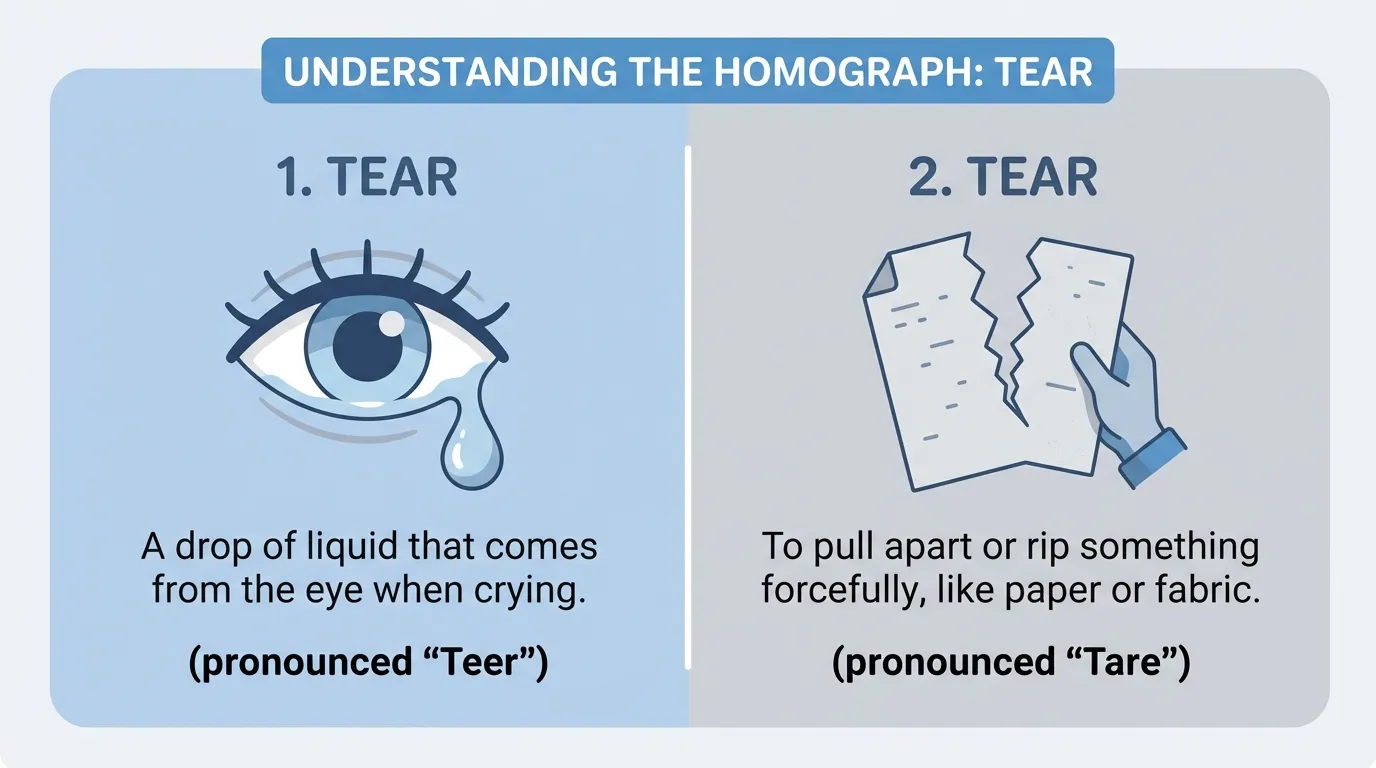
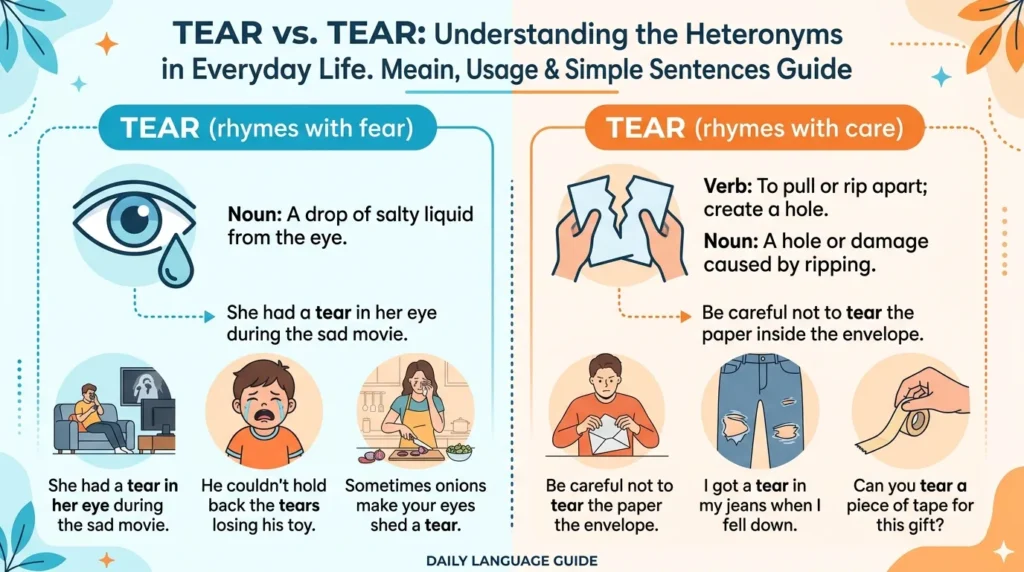
One “tear” means a drop of water from the eye when someone cries. It is pronounced like “teer.” The other “tear” means to rip or break something. It is pronounced like “tare.”
Because the spelling is identical, many people struggle to understand which meaning is correct in a sentence. Context is the key. For example, “She wiped away a tear” relates to crying, while “Do not tear the paper” means ripping something.
Understanding the difference between these two words helps improve pronunciation, spelling confidence, reading comprehension, and writing accuracy. This guide explains the meanings, origins, examples, common mistakes, and correct usage of tear or tear in simple English.
Tear or Tear : Quick Answer
“Tear” can have two different meanings depending on pronunciation and context.
- Tear (teer) = a drop from the eye
- Tear (tare) = to rip or pull apart
Examples
- “A tear rolled down his face.” → crying
- “Please do not tear the document.” → ripping
The Origin of Tear or Tear
The two words come from different historical roots even though they share the same spelling.
Tear (teer)
This version comes from Old English words related to crying and eye drops.
Tear (tare)
This version comes from Old English and Germanic roots meaning “to pull apart” or “rip.”
Over time, English kept the same spelling for both words, creating pronunciation confusion.
British English vs American English Spelling
There is no spelling difference between British and American English.
| Word | British English | American English | Pronunciation |
| Tear (crying) | Tear | Tear | Teer |
| Tear (rip) | Tear | Tear | Tare |
Example Usage
| Sentence | Meaning |
| “She cried a tear.” | Eye drop |
| “Do not tear the page.” | Rip apart |
Which Spelling Should You Use?
The spelling stays the same. The difference depends on pronunciation and sentence meaning.
Use “Tear” (Teer) When:
- Talking about crying
- Describing emotions
- Referring to eye drops
Use “Tear” (Tare) When:
- Talking about ripping paper or fabric
- Describing damage
- Referring to pulling apart
Audience Advice
| Audience | Recommendation |
| English learners | Focus on pronunciation |
| Students | Use context clues |
| Global readers | Same spelling worldwide |
| Formal writing | Make meaning clear through context |
Common Mistakes with Tear or Tear
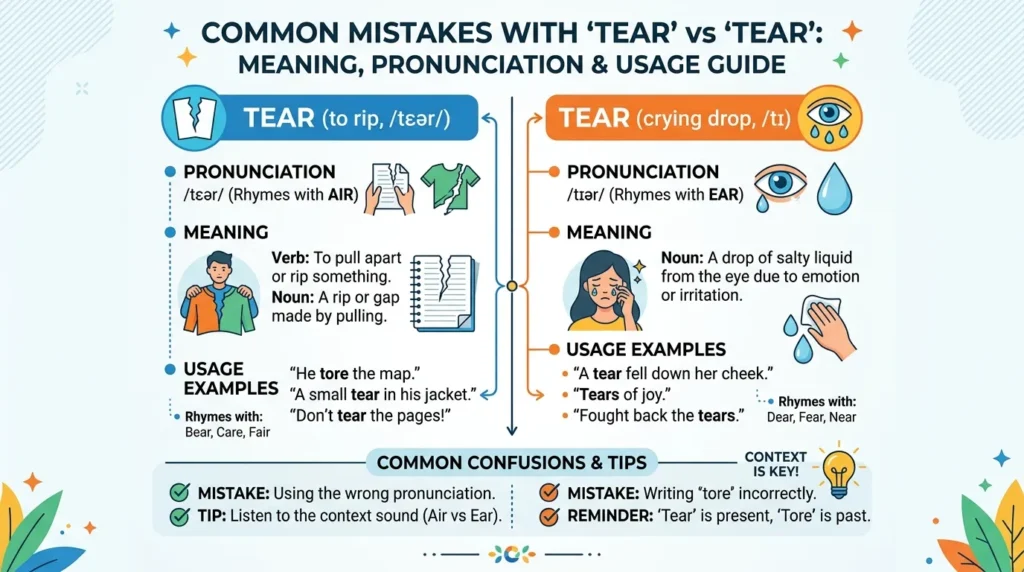
Many people pronounce or understand the wrong meaning.
| Incorrect | Correct |
| “He tare a tear from his eye.” | “He wiped a tear from his eye.” |
| “Please teer the paper.” | “Please tare the paper.” |
| Confusing pronunciation | Use context to guide meaning |
Why These Mistakes Happen
- Same spelling
- Different pronunciations
- Fast reading
- English learning challenges
Tear or Tear in Everyday Examples
Emails
- “There was a tear in the package.”
- “Her message brought a tear to my eye.”
News
- “The storm caused a tear in the tent roof.”
- “Fans shed tears after the final match.”
Social Media
- “That movie made me cry a tear.”
- “I accidentally tore my favorite shirt!”
Formal Writing
- “The fabric showed signs of wear and tear.”
- “A tear formed during the emotional speech.”
Tear or Tear : Google Trends & Usage Data
Search data shows strong interest in “tear or tear” because learners want pronunciation help.
Popular Search Reasons
- English pronunciation confusion
- Homograph examples
- Grammar lessons
- Reading comprehension
Regional Interest
| Region | Common Search |
| United States | Tear pronunciation |
| United Kingdom | Tear meaning |
| India | Tear vs tear |
| Global English learners | Pronunciation help |
People usually search this keyword while learning spoken English.
Comparison Table: Tear vs Tear
| Feature | Tear (Teer) | Tear (Tare) |
| Meaning | Eye drop | Rip apart |
| Pronunciation | Teer | Tare |
| Usage | Emotions | Damage or ripping |
| Part of Speech | Noun | Verb |
| Example | “A tear fell.” | “Do not tear it.” |
FAQs
1. Why are tear and tear spelled the same?
English has homographs, which are words with the same spelling but different meanings and pronunciations.
2. How do you pronounce tear when crying?
It is pronounced “teer.”
3. How do you pronounce tear when ripping?
It is pronounced “tare.”
4. Are both words correct?
Yes. Both are correct depending on context.
5. Is there a spelling difference in British English?
No. The spelling stays the same worldwide.
6. What type of word is tear or tear?
It is a homograph.
7. Which meaning is more common?
Both are very common in daily English.
Conclusion
The words “tear” and “tear” are a common source of confusion because they look identical but have different meanings and pronunciations. One version refers to crying and is pronounced “teer.” The other means ripping something and is pronounced “tare.”
There is no spelling difference between British and American English, so understanding context is very important. If the sentence talks about emotions or crying, “tear” means an eye drop. If the sentence talks about damage or ripping, “tear” means to pull apart.
These words are examples of English homographs, which can be difficult for learners at first. However, paying attention to pronunciation and sentence meaning makes understanding much easier.
Learning the difference between tear and tear improves reading, speaking, and writing skills while helping avoid common pronunciation mistakes.
Read more about !
Superhero vs. Villain: What’s the Difference? 🦸♂️🦹♂️ 🦸♂️🦹♂️
Aquaphor vs. Vaseline: Which Skin Care Product Is Better? 🧴🧴✨

I am an English author who loves words and their meaning. Writing is not just my work, it is my passion. I write to make English simple, clear, and easy to understand for everyone. My focus is on real language, real mistakes, and real learning. Every article I write comes from research, experience, and a love for honest writing. My goal is simple: help readers feel confident with English.