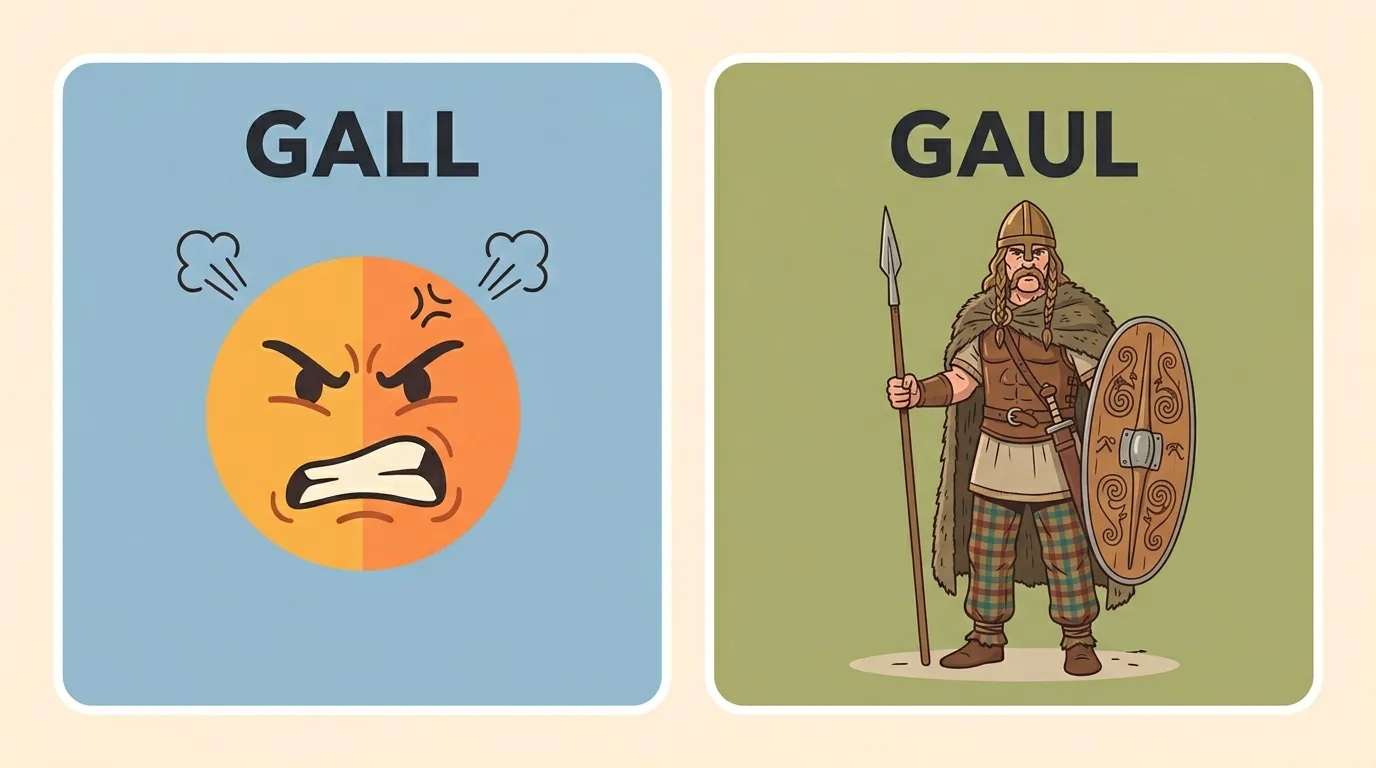
“Gall” means boldness or bitterness, while “Gaul” refers to an ancient region that is now mostly modern-day France.
Many people search for “gall or gaul” because the two words sound exactly alike but have very different meanings. This confusion often happens in writing, school assignments, history discussions, and everyday conversations. Since both words are pronounced the same way, it is easy to pick the wrong spelling by mistake.
The word gall usually means bold behavior, bitterness, or irritation. For example, someone may say, “He had the gall to complain.” It can also relate to bitterness or medical terms involving the body.
The word Gaul refers to an ancient region in Western Europe that is now mostly modern-day France. It is commonly used in history books and discussions about the Roman Empire.
Understanding the difference between gall and Gaul helps improve spelling accuracy and prevents embarrassing mistakes in formal writing. This guide explains the meanings, origins, spelling rules, examples, and common errors in simple language.
Gall or Gaul : Quick Answer
Gall means boldness, bitterness, or irritation.
Gaul refers to an ancient European region ruled by the Romans.
Examples
- “She had the gall to interrupt the meeting.”
- “Julius Caesar conquered Gaul.”
The Origin of Gall or Gaul
Gall
The word “gall” comes from Old English and Latin roots connected to bitterness and anger. Over time, it also became linked with courage or rude boldness.
Gaul
“Gaul” comes from the Latin word Gallia, the Roman name for the ancient region that covered much of modern France and nearby areas.
The confusion happens because both words sound identical in English pronunciation.
British English vs American English Spelling
There is no spelling difference between British and American English for these words.
| Word | British English | American English | Meaning |
| Gall | Gall | Gall | Boldness or bitterness |
| Gaul | Gaul | Gaul | Ancient European region |
Example Usage
| Sentence | Correct Word |
| “The gall of that comment shocked everyone.” | Gall |
| “Ancient Gaul was part of Roman history.” | Gaul |
Which Spelling Should You Use?
Choose the spelling based on meaning and context.
Use “Gall” When:
- Talking about rude boldness
- Describing bitterness or irritation
- Using emotional expressions
Use “Gaul” When:
- Discussing Roman history
- Referring to ancient France
- Writing historical content
Audience Advice
| Audience | Recommended Word |
| General writing | Gall |
| History students | Gaul |
| Academic writing | Context-based |
| Global audience | Same spelling everywhere |
Common Mistakes with Gall or Gaul
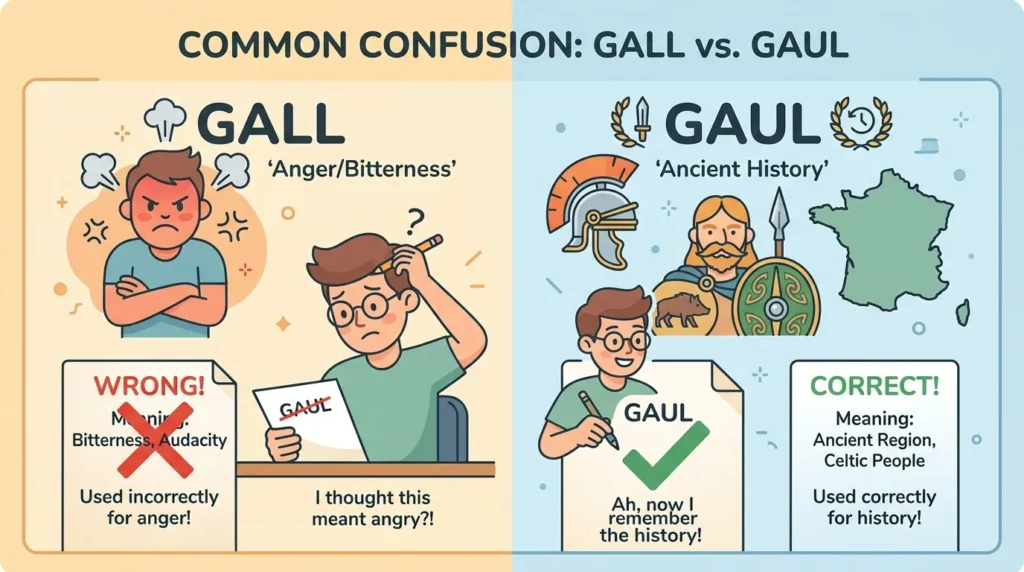
Many people mix these words because they sound alike.
| Incorrect | Correct |
| “The Gaul of that man!” | “The gall of that man!” |
| “Rome invaded gall.” | “Rome invaded Gaul.” |
| “She had the gaul to argue.” | “She had the gall to argue.” |
Why These Mistakes Happen
- Same pronunciation
- Autocorrect confusion
- Lack of historical context
- Fast typing mistakes
Gall or Gaul in Everyday Examples
Emails
- “I cannot believe the gall of that response.”
News
- “Archaeologists discovered artifacts from ancient Gaul.”
Social Media
- “The gall of some internet comments is unbelievable!”
Formal Writing
- “Gaul played an important role in Roman history.”
Gall or Gaul : Google Trends & Usage Data
Search data shows that “gall” is searched more often because it appears in everyday speech and expressions.
“Gaul” is mostly searched in:
- History classes
- Roman Empire topics
- Educational content
Regional Interest
| Region | Popular Search |
| United States | Gall |
| United Kingdom | Gall |
| France | Gaul |
| Educational searches | Gaul |
Most spelling confusion happens when people hear the word before seeing it written.
Comparison Table: Gall vs Gaul
| Feature | Gall | Gaul |
| Meaning | Boldness or bitterness | Ancient European region |
| Common Use | Everyday language | Historical writing |
| Part of Speech | Noun | Proper noun |
| Popularity | Very common | Less common |
| Topic Area | Emotions and behavior | Roman history |
FAQs
1. Is “gaul” a correct spelling?
Yes. “Gaul” is correct when talking about ancient France.
2. What does “gall” mean?
It means rude boldness, bitterness, or irritation.
3. Why do people confuse gall and Gaul?
They sound exactly the same when spoken.
4. Is Gaul related to modern France?
Yes. Ancient Gaul covered much of present-day France.
5. Which word is more common?
“Gall” is more common in daily English.
6. Is there a British spelling difference?
No. Both spellings stay the same worldwide.
7. Can gall be used in formal writing?
Yes. It is commonly used in both formal and informal English.
Conclusion
The difference between “gall” and “Gaul” is simple once the meanings are clear. “Gall” refers to boldness, bitterness, or rude behavior, while “Gaul” is the historical name for an ancient European region connected to Roman history.
Even though the words sound identical, their meanings are completely different. Most everyday conversations use “gall,” especially in expressions like “the gall of someone.” “Gaul” mainly appears in history books, documentaries, and educational writing.
There are no spelling differences between British and American English, so the correct choice depends entirely on context. If discussing emotions or rude behavior, use “gall.” If talking about Roman history or ancient France, use “Gaul.”
Understanding the difference improves writing accuracy and helps avoid common spelling mistakes in school, work, and online communication.
Read more about!
Brinks vs. ADT: Which Security System Is Better? 🔒 🏠🔐
LLC vs Incorporated: Which Is Better? 🏢

Hye ! I am Henry P. Whitmore i am English writer known for my clear and practical approach to English grammar, word usage, and language clarity. I focuses on helping learners, writers, and professionals understand confusing English terms in a simple way. My work is especially useful for people who struggle with spelling differences, word meanings, and correct usage in everyday writing