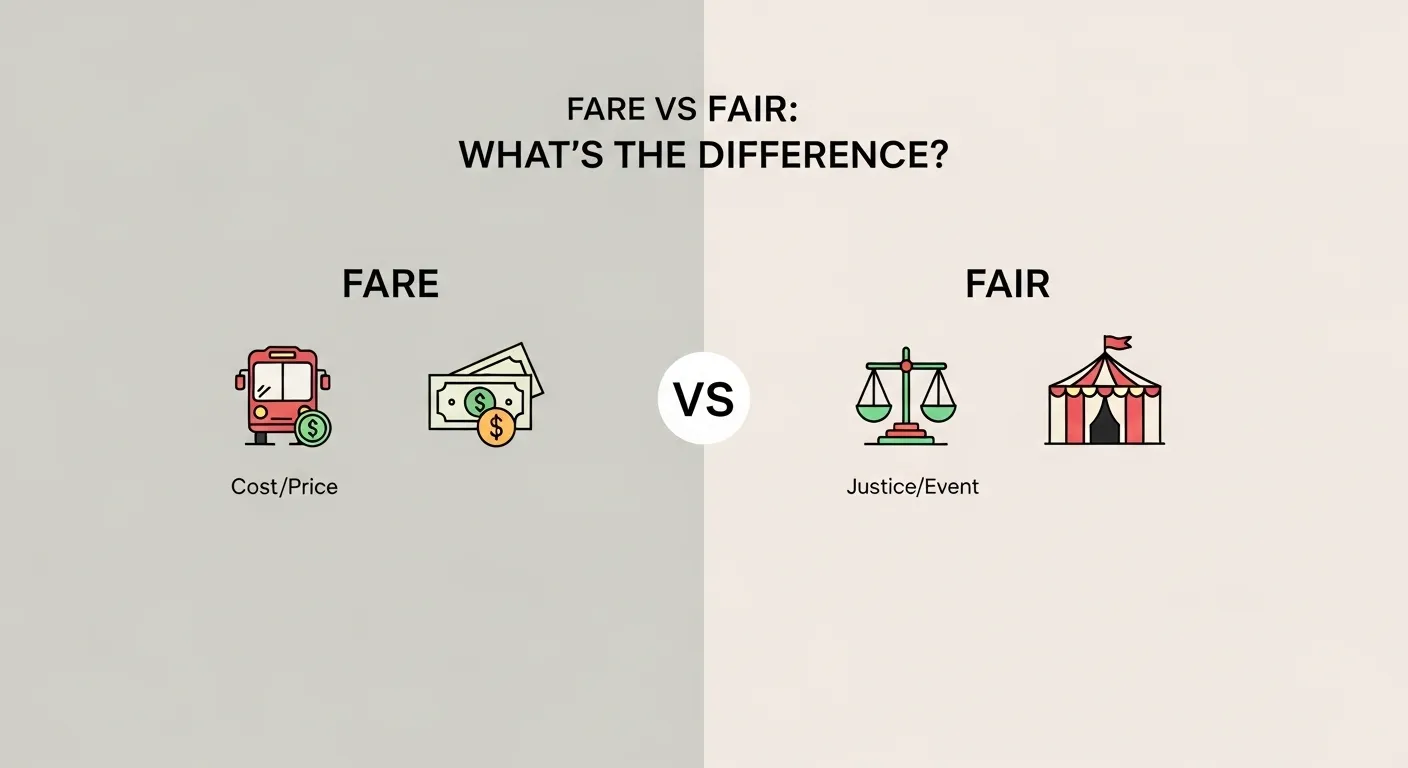
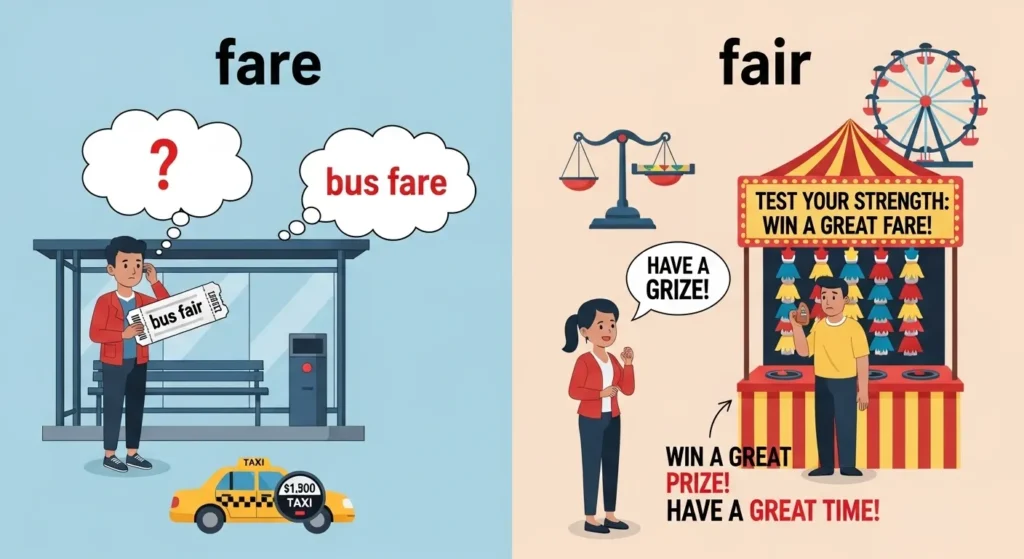
Fare usually refers to a price or cost (like a bus fare), while fair means just, equal, or a public event 🎟️⚖️.
“Fare or fair?” 🤔 These two words look similar, sound similar, but have very different meanings. This is why many English learners get confused when writing or speaking.
You might see “fare” on bus tickets 🚌, while “fair” appears in phrases like “fair price” or “fair event.” Because they sound the same, people often mix them up in writing.
This confusion is very common in exams, emails, travel bookings, and everyday conversations. One wrong word can completely change the meaning of your sentence.
People search this keyword because they want a simple explanation. They want to know which word to use in different situations and how to avoid mistakes.
The good news is that the difference is easy once you understand it. In this guide, we will explain meanings, origins, examples, and correct usage in simple language. Let’s clear the confusion step by step. ✅
Fare or Fair : Quick Answer
- Fare 🎟️ → Money paid for travel or transport
- Fair 🎡 → Just, equal, or an event/exhibition
Examples:
- Bus fare is $2 🚌
- That is not fair! ⚖️
👉 Simple rule:
Fare = Money/Travel | Fair = Equality/Event
The Origin of Fare or Fair
Fare
The word fare comes from Old English “faran”, meaning “to travel.” Over time, it became linked with the cost of travel.
Fair
The word fair comes from Old English “fæger”, meaning “beautiful or pleasing.” Later, it developed meanings like “just” and “equal.”
👉 Key idea:
- Fare = travel cost
- Fair = justice, beauty, or event
British English vs American English Spelling
There is no spelling difference between British and American English for these words.
| Word | British English 🇬🇧 | American English 🇺🇸 | Meaning |
| Fare | Fare | Fare | Travel cost |
| Fair | Fair | Fair | Just / Event |
👉 Both are used the same worldwide.
Which Spelling Should You Use?
Always choose based on meaning, not region.
Use Fare when:
- Talking about transport cost 🚌
- Discussing tickets or travel
Use Fair when:
- Talking about justice ⚖️
- Referring to events or exhibitions 🎡
Audience Advice:
- Students: Learn context carefully
- Travel writing: Use “fare”
- General writing: Use “fair” correctly
👉 Tip: Meaning is everything here.
Common Mistakes with Fare or Fair
Here are common errors:
Writing “fair” instead of “fare” for tickets
✔️ “Bus fare” is correct
Mixing meanings in sentences
✔️ Use correct context
Thinking they are interchangeable
✔️ They are completely different
Ignoring pronunciation clues
✔️ Sound is same but meaning differs
👉 Always check meaning before writing.
Fare or Fair in Everyday Examples
Emails
- “The taxi fare has increased.”
- “We hope the decision is fair.”
News
- “Airline fares rise during holidays.”
- “The trial was fair and transparent.”
Social Media
- “That price is not fair 😤”
- “Bus fare too expensive today 🚌”
Formal Writing
- “The transport fare is regulated by law.”
- “All participants received fair treatment.”
Fare or Fair: Google Trends & Usage Data
Search trends show:
- Fair is used much more globally 🌍
- Fare is specific to travel and transport
By Region:
- USA → Both commonly used
- UK → “fair” used more in daily speech
- Global → “fair” dominates overall usage
Context:
- Travel industry → “fare”
- Justice, events, opinions → “fair”
👉 “Fair” is far more common in general writing.
Comparison Table: Fare vs Fair
| Aspect | Fare 🎟️ | Fair 🎡 |
| Meaning | Travel cost | Just / Event |
| Usage | Transport | General use |
| Context | Money | Equality |
| Example | Bus fare | Fair decision |
| Frequency | Less common | Very common |
Detailed Comparison
1. Meaning
- Fare → Money paid for travel
- Fair → Justice, equality, or event
2. Usage
- Fare → Tickets, transport
- Fair → Opinions, rules, exhibitions
3. Tone
- Fare → Practical
- Fair → Emotional or descriptive
In short:
👉 Fare = Travel cost
👉 Fair = Just / Event
FAQs
1. What is the difference between fare and fair?
Fare is travel cost, fair means just or an event.
2. Is “fair” used for travel tickets?
No, use “fare” instead.
3. Can they be used interchangeably?
No, they have different meanings.
4. What does bus fare mean?
It is the price of a bus ticket.
5. What does “that’s not fair” mean?
It means something is unjust.
6. Are they pronounced the same?
Yes, they are homophones.
7. Which is more common?
“Fair” is more commonly used in everyday English.
Conclusion
The difference between fare or fair is simple once you understand the meaning. Even though they sound the same, they are completely different words with different uses.
Fare is used when talking about travel costs, tickets, and transportation. For example, bus fare or taxi fare. It is mostly used in practical and financial contexts.
Fair, on the other hand, has multiple meanings. It can mean something is just, equal, or reasonable. It can also refer to an event or exhibition. Because of this, it is used much more often in everyday English.
There is no difference between British and American English in spelling. The real difference comes from meaning and context.
To avoid mistakes, always ask yourself: Am I talking about money for travel or something just and equal? That simple question will guide you correctly.
Read more about!
Were vs. We’re: Know the Difference in Seconds
Huggies vs Pampers for Babies 👶
.

I am James Whitmore. I love clear and honest English. I write to make hard words feel simple. My goal is to help readers write with confidence, without fear or confusion.