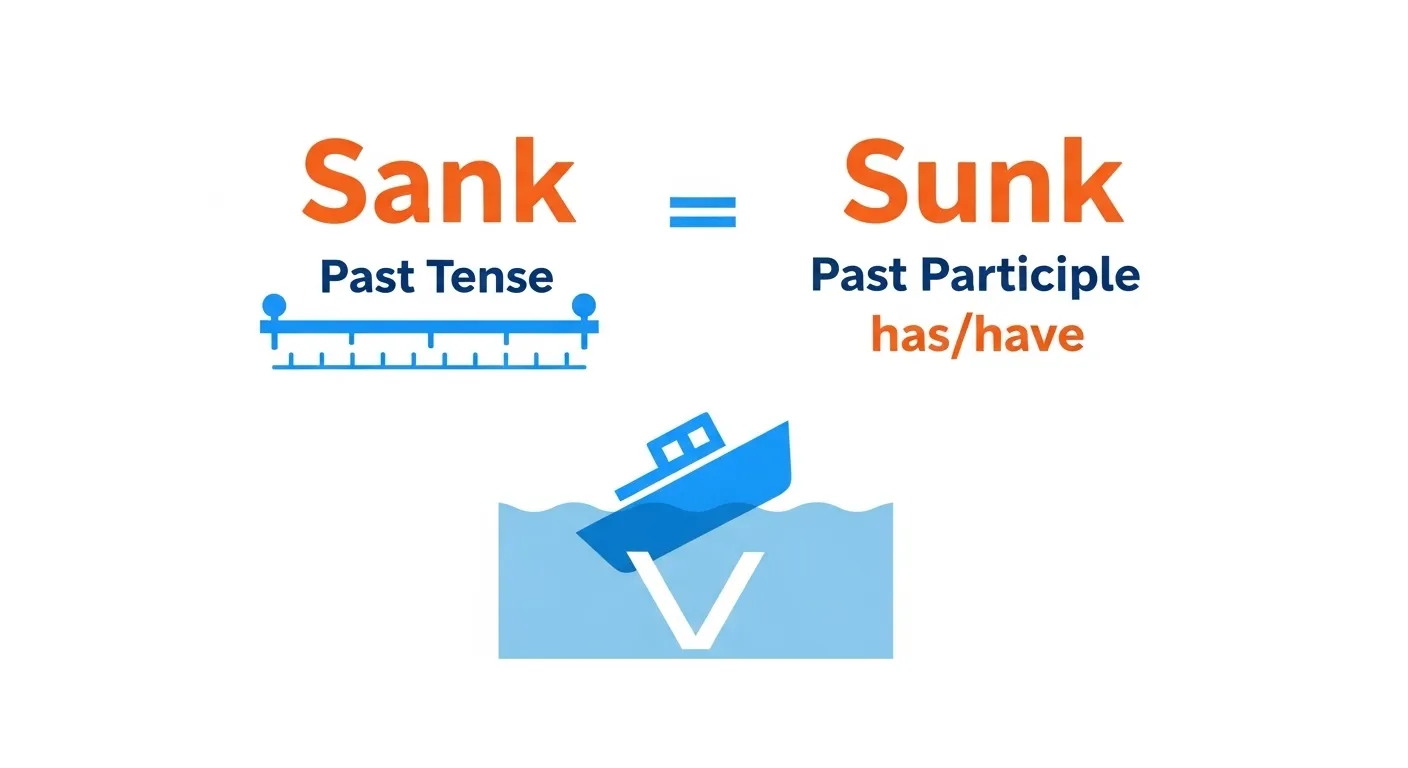
“Sank is the simple past tense of ‘sink,’ while sunk is used with helping verbs (e.g., ‘has sunk’) 😊.”
Many English learners get confused between “sank” and “sunk.” 🤔 Both words come from the verb “sink,” but knowing when to use each one is not always easy.
You might hear someone say “The ship sank,” while others say “The ship has sunk.” So which one is correct? This confusion is very common in writing, exams, and everyday English conversations.
People search “sank or sunk” because they want a simple rule that explains when to use each form. The problem becomes even harder because English has irregular verbs, and “sink” is one of them.
Using the wrong form can make your sentence sound unnatural or grammatically incorrect. That is why it is important to understand the difference clearly.
In this guide, we will explain the meanings, grammar rules, examples, and correct usage in very simple language. By the end, you will never confuse sank and sunk again. 🚀
Sank or Sunk : Quick Answer
- Sank ⬇️ → Simple past tense of sink
- Sunk ⬇️ → Past participle of sink
Examples:
- The ship sank yesterday 🚢
- The ship has sunk completely 🚢
👉 Simple rule:
Sank = past action | Sunk = completed action (perfect tense)
The Origin of Sank or Sunk
The verb “sink” comes from Old English “sincan,” meaning “to go down or submerge.”
Over time, English developed irregular verb forms:
- Present: sink
- Past: sank
- Past participle: sunk
👉 Key idea:
English irregular verbs changed historically, not by spelling rules but by usage evolution.
British English vs American English Spelling
There is no difference between British and American English for these forms.
| Form | British English 🇬🇧 | American English 🇺🇸 | Meaning |
| Present | sink | sink | go down |
| Past | sank | sank | went down |
| Past Part. | sunk | sunk | gone down |
👉 These forms are universal in all English varieties.
Which Spelling Should You Use?
Use depends on grammar structure, not region.
Use sank when:
- Talking about a finished action in the past ⏳
- Example: The boat sank last night
Use sunk when:
- Using perfect tenses (has/have/had)
- Example: The boat has sunk
Audience Advice:
- Students: Learn verb patterns carefully
- Writers: Use correct tense structure
- Speakers: Practice natural usage
👉 Grammar decides, not preference.
Common Mistakes with Sank or Sunk
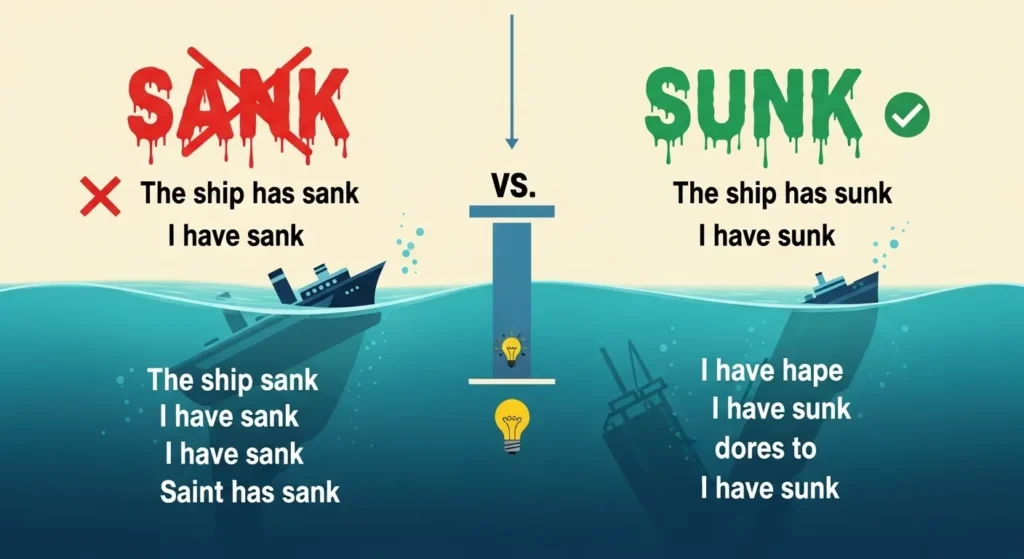
“The ship has sank”
✔️ The ship has sunk
“The ship sunk yesterday”
✔️ The ship sank yesterday
Mixing tenses incorrectly
✔️ Use sank for simple past, sunk for perfect tenses
Assuming both are interchangeable
✔️ They are not interchangeable
Sank or Sunk in Everyday Examples
News Reports
- “The boat sank during the storm.”
- “The ship has sunk in deep waters.”
Emails
- “The system sank under heavy load.”
- “Data has sunk due to error.”
Social Media
- “My mood sank after the news 😔”
- “Confidence has sunk completely 📉”
Conversations
- “The ship sank fast!”
- “It has sunk already.”
Sank or Sunk : Google Trends & Usage Data
Search behavior shows:
- “Sunk” is searched more in grammar contexts 📚
- “Sank” is more common in storytelling and news 📰
By Region:
- USA → Balanced usage
- UK → Slight preference for “sank” in speech
- Global learners → Confusion is very common
Context:
- Grammar learning → sunk dominates
- Past storytelling → sank dominates
👉 Both forms are widely used correctly depending on tense.
Comparison Table: Sank vs Sunk
| Feature | Sank ⬇️ | Sunk ⬇️ |
| Tense | Simple past | Past participle |
| Usage | Finished action | Perfect tense |
| Example | The ship sank | It has sunk |
| Grammar Role | Verb form | Verb form |
| Correct Use | Yesterday events | Completed actions |
Detailed Comparison
1. Grammar Role
- Sank → past action
- Sunk → completed result
2. Sentence Structure
- Sank → used alone
- Sunk → used with helping verbs
3. Meaning
- Both describe “going down” but in different tenses
FAQs
1. What is the difference between sank and sunk?
Sank is past tense, sunk is past participle.
2. Is it “has sunk” or “has sank”?
Correct: has sunk.
3. Can I say “the boat sunk yesterday”?
No, correct form is “the boat sank yesterday.”
4. Which is correct: sunk or sank?
Both are correct in different grammar situations.
5. What is the present form of sink?
Sink is the present tense.
6. Is sunk more formal than sank?
No, both are standard grammar forms.
7. Why are there two forms?
Because English has irregular verb patterns.
Conclusion
The confusion between sank or sunk is very common, but the rule is actually simple once you understand English grammar.
Sank is the simple past form of “sink,” used when talking about a completed action in the past. For example, “The ship sank yesterday.”
Sunk is the past participle form, used with helping verbs like “has,” “have,” or “had.” For example, “The ship has sunk.”
Both words are correct, but they cannot be used interchangeably. The meaning depends on sentence structure and tense.
There is no difference between British and American English for these forms. The usage is universal across all English speakers.
To avoid mistakes, always check your sentence structure:
- If it is a simple past action → use sank
- If it is perfect tense → use sunk
In short:
👉 Sank = past event
👉 Sunk = completed action
Once you remember this rule, you will never confuse them again in writing or speaking.
Read more about!
Red or White: Which One Should You Choose? 🔴⚪
Gall vs. Gaul: What’s the Difference? ⚔️📖

I am an English author who loves words and their meaning. Writing is not just my work, it is my passion. I write to make English simple, clear, and easy to understand for everyone. My focus is on real language, real mistakes, and real learning. Every article I write comes from research, experience, and a love for honest writing. My goal is simple: help readers feel confident with English.