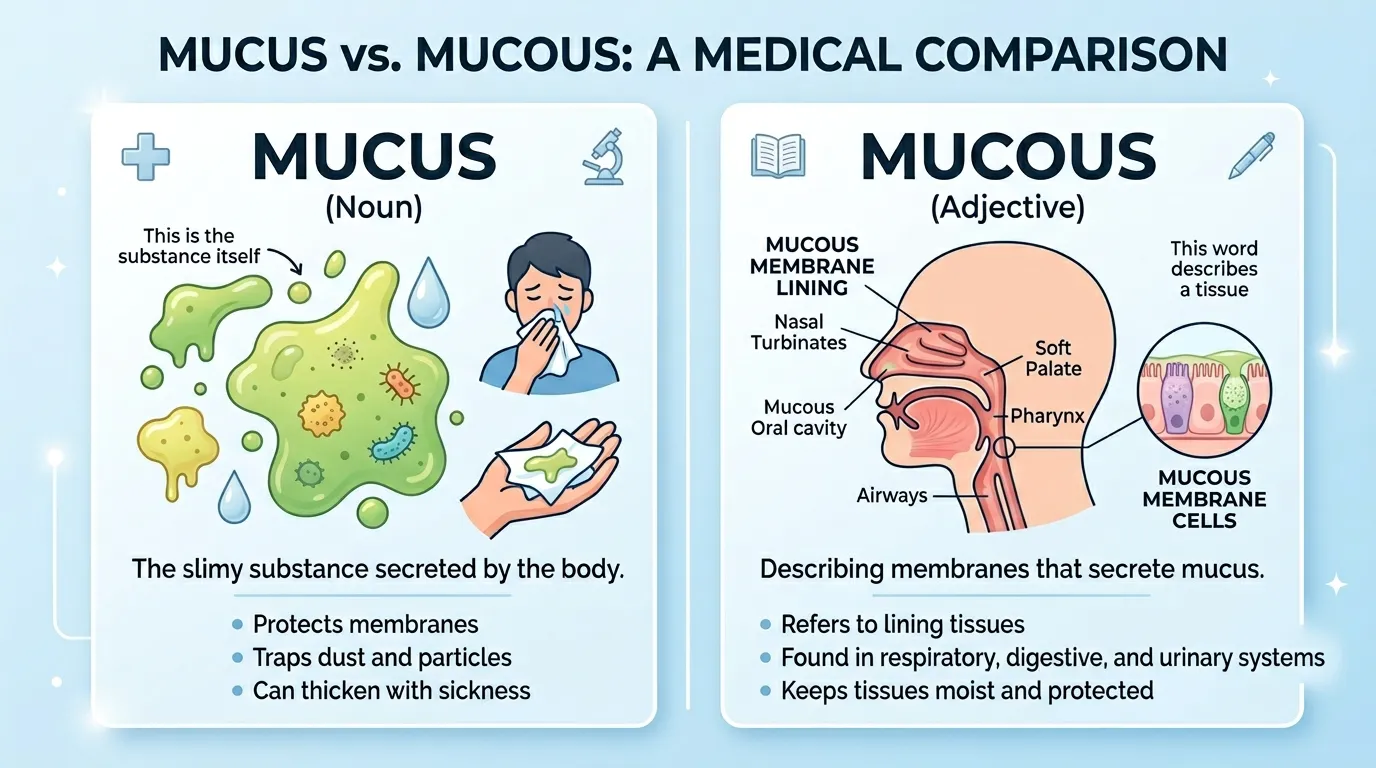
“Mucus” is a noun for the slimy substance in your body, while “mucous” is an adjective used to describe tissues or membranes that produce it. 🤧✍️
Many people get confused between the words “mucus” and “mucous.” They look almost the same, but they are not used in the same way. This small spelling difference often causes big grammar mistakes in writing, medical discussions, and even search queries. That is why people frequently search for “mucus or mucous” to understand which one is correct and when to use each term.
The confusion usually happens because both words are related to the same thing in the body the sticky substance found in the nose, throat, and lungs. However, one is a noun and the other is an adjective. This simple grammar rule changes their meaning completely.
In this guide, you will learn the quick difference between mucus and mucous, their origin, correct usage, common mistakes, and real-life examples. You will also see how doctors, writers, and everyday users apply these words correctly. By the end, you will never confuse them again and will confidently use both terms in the right context.
Mucus or Mucous : Quick Answer
Mucus is a noun that refers to the sticky substance in the body.
Mucous is an adjective that describes something related to mucus.
Examples:
- Mucus → “I have mucus in my nose.”
- Mucous → “The mucous membrane is irritated.”
The Origin of Mucus or Mucous
Both words come from the Latin word “mucus,” meaning slimy fluid. Over time, English created two forms:
- Mucus → noun form
- Mucous → adjective form
This split helped scientists and doctors describe the substance and related tissues more clearly.
British English vs American English Spelling
There is no difference in spelling between British and American English for these words. Both regions use the same forms: mucus and mucous.
The difference is only in usage context, not spelling rules.
Comparison Table
| Word | Type | Meaning | Example |
| Mucus | Noun | Sticky body fluid | Nose mucus |
| Mucous | Adjective | Related to mucus | Mucous membrane |
Which Spelling Should You Use?
- Use “mucus” when talking about the substance itself
- Use “mucous” when describing body tissues or surfaces
Audience advice:
- Medical writing → Both (correct context matters)
- Everyday writing → Mostly “mucus”
- School/learning → Learn both forms
Common Mistakes with Mucus or Mucous
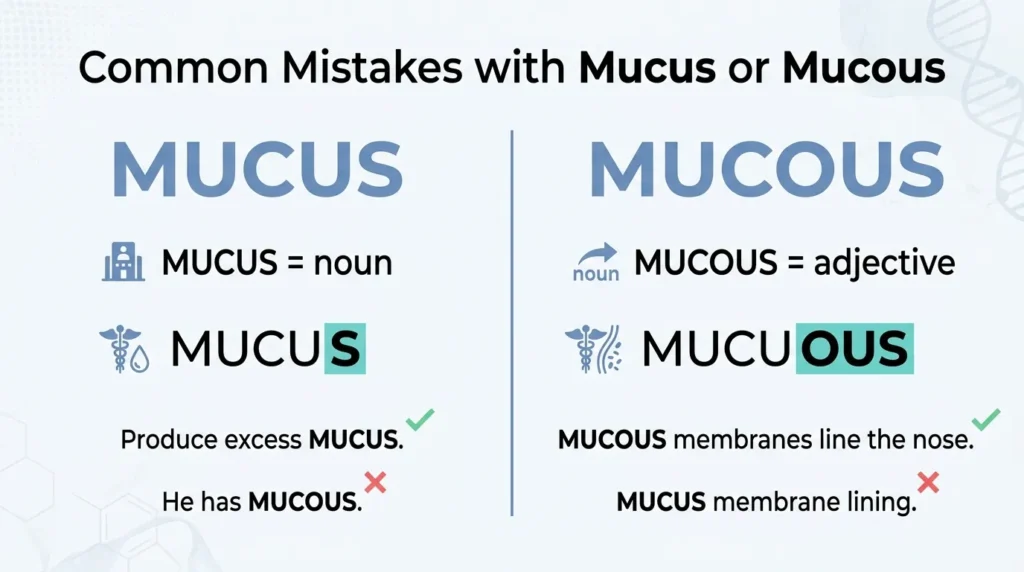
- Using “mucous” instead of “mucus”
- Saying “nose mucous” instead of “nose mucus”
- Thinking both words mean the same thing
- Mixing noun and adjective forms
Correction:
Always check if you are naming the substance or describing something.
Mucus or Mucous in Everyday Examples
Emails:
- “The patient has excess mucus in the respiratory system.”
Medical reports:
- “Inflammation of the mucous membrane observed.”
Social media:
- “Cold season = too much mucus 🤧”
News articles:
- “Researchers study mucous tissues in lung diseases.”
Mucus or Mucous : Google Trends & Usage Data
Search data shows high interest in both terms, especially in:
- Health-related searches
- Medical students and writers
- English grammar learners
Respiratory infections topics often trigger searches for “mucus,” while scientific writing increases usage of “mucous.”
Comparison Table: Mucus vs Mucous
| Feature | Mucus 🧪 | Mucous 🧫 |
| Word type | Noun | Adjective |
| Meaning | Substance | Related to mucus |
| Usage | Common speech | Medical/scientific |
| Example | Nose mucus | Mucous membrane |
FAQs
1. Is mucus or mucous correct?
Both are correct but used differently.
2. What is mucus?
A sticky fluid produced by the body.
3. What is mucous?
An adjective describing mucus-related tissues.
4. Can I use mucous instead of mucus?
No, it changes the meaning.
5. Why do people confuse them?
Because they look and sound similar.
6. Is mucus a medical term?
Yes, it is commonly used in medicine.
7. What is a mucous membrane?
A body lining that produces mucus.
Conclusion
Understanding the difference between mucus and mucous is simple but important. These two words are often confused because they come from the same root and relate to the same biological process. However, their grammatical roles are different.
Mucus is a noun that refers to the sticky fluid produced by the body to protect and lubricate surfaces like the nose, throat, and lungs. It is the word most people use in everyday life.
Mucous, on the other hand, is an adjective. It describes tissues or membranes that produce or are related to mucus. You will mostly see it in medical or scientific writing, such as “mucous membrane.”
By remembering this simple rule mucus = thing, mucous = describing word you can avoid one of the most common English mistakes. Ifr you are writing emails, studying biology, or reading health articles, using the correct form will make your communication clearer and more professional.
Read more about!
LLC or LLP: Which Business Structure Is Right for You? 💼📊
Superhero vs. Villain: What’s the Difference? 🦸♂️🦹♂️ 🦸♂️🦹♂️

Hye ! I am Henry P. Whitmore i am English writer known for my clear and practical approach to English grammar, word usage, and language clarity. I focuses on helping learners, writers, and professionals understand confusing English terms in a simple way. My work is especially useful for people who struggle with spelling differences, word meanings, and correct usage in everyday writing