
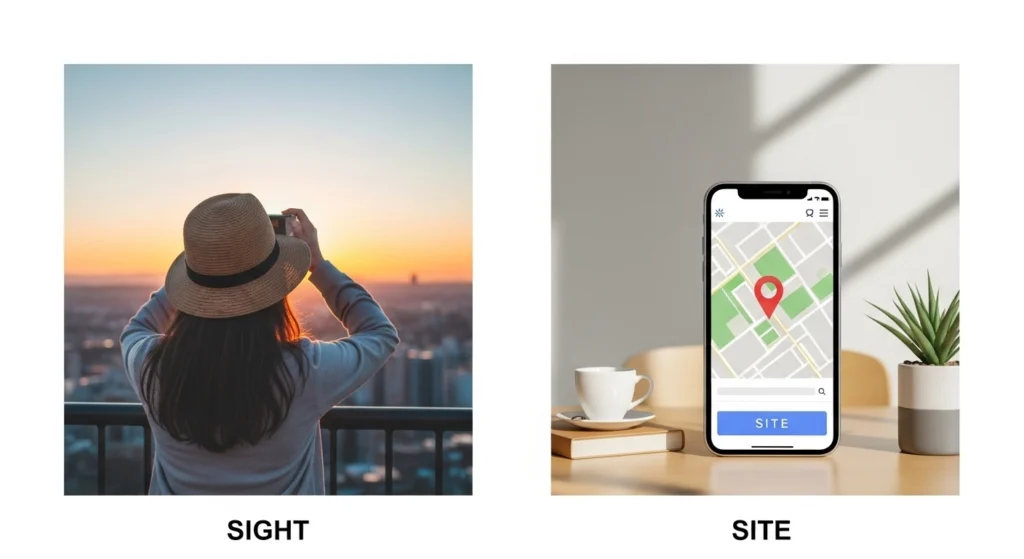
Sight refers to vision or the ability to see 👀, while Site refers to a location or place 📍.
Many English learners and writers often get confused between “sight” and “site.” Both words sound the same but have very different meanings.
Using the wrong word can change your sentence completely and make your writing look unprofessional.
People search for “sight or site” because they want to write clearly in emails, social media, essays, or formal documents.
This confusion is common due to English homophones words that sound alike but have different spellings and meanings.
Knowing the difference helps you communicate accurately and avoid embarrassing mistakes.
In this article, we will explore the meanings of sight and site, their origins, compare British and American usage, highlight common mistakes, and provide examples for everyday writing.
By the end, you will confidently know which word to use in every situation.
Sight or Site ; Quick Answer
- Sight → Refers to the ability to see, something you see, or a view.
- Example: The Grand Canyon is an amazing sight.
- Example: The Grand Canyon is an amazing sight.
- Site → Refers to a location, place, or position.
- Example: The construction site is near the river.
- Example: The construction site is near the river.
✅ Quick Tip: Use sight for vision or view, site for location or place.
Read more about: Hoping or Hopeing: Which Spelling Is Correct?
The Origin of Sight or Site
- Sight comes from Old English siht, meaning vision or view. It has been used for centuries to describe seeing or something seen.
- Site comes from Latin situs, meaning position or place. It entered English in the 14th century to describe a specific location or setting.
- Over time, the two words evolved separately but sound the same, creating the current confusion.
British English vs American English Spelling
Both British and American English use the same spellings for sight and site. The difference is in meaning, not spelling.
| Word | British English | American English | Usage Notes |
| Sight | ✅ Correct | ✅ Correct | Refers to vision, view, or something seen |
| Site | ✅ Correct | ✅ Correct | Refers to location, place, or position |
Which Spelling Should You Use?
- US audience: Use sight for seeing, site for location.
- UK/Commonwealth audience: Same rules apply.
- Global writing: Stick with sight for vision/view and site for location/place to avoid confusion.
Common Mistakes with Sight or Site
- Using site when referring to something seen. ❌
- Wrong: The Eiffel Tower is a beautiful site.
- Correct: The Eiffel Tower is a beautiful sight. ✅
- Wrong: The Eiffel Tower is a beautiful site.
- Using sight when referring to a location. ❌
- Wrong: The building site is downtown. (correct)
- Wrong: The building sight is downtown. ❌
- Wrong: The building site is downtown. (correct)
- Confusing the two words in formal writing or academic papers. Always check the context.
Sight or Site in Everyday Examples
Emails:
- The garden offers a stunning sight in spring.
- Please visit the site to check the construction progress.
Social Media:
- Caught this amazing sight during my hike!
- Check out our new website site for more details.
News Headlines:
- Sight of the new sculpture amazes locals.
- Construction site safety guidelines released today.
Formal Writing:
- The conference was held at a prime site downtown.
- The sunset provided a memorable sight for attendees.
Sight or Site ; Google Trends & Usage Data
Analysis of Google search trends shows:
- Sight is often searched in contexts related to vision, travel, and photography.
- Site is frequently searched in construction, real estate, and web-related contexts.
- Confusion arises in beginners’ writing and students’ essays.
| Keyword | Global Search Popularity | Notes |
| Sight | High | Vision, view, photography |
| Site | High | Location, construction, web |
Keyword Variations Comparison Table
| Word | Correctness | Example Sentence |
| Sight | ✅ Correct | The mountain view was a breathtaking sight. |
| Site | ✅ Correct | The wedding site was decorated beautifully. |
FAQs
1. Can I use “site” when talking about seeing something?
No, use sight for vision or view.
2. Can “sight” refer to a location?
No, it refers to vision, view, or something seen. Use site for locations.
3. Are these words spelled differently in British and American English?
No, the spellings are the same; the difference is in meaning.
4. How can I remember which to use?
Think: sight = see, site = place.
5. Can “sight” be used metaphorically?
Yes, e.g., He came into sight of his dreams.
6. Can “site” refer to a website?
Yes, “site” is commonly used to mean a web location.
7. Is confusing these words a common mistake?
Yes, especially among English learners and students.
Conclusion
In conclusion, sight and site are homophones with very different meanings. Sight relates to vision, view, or something seen, while site refers to a location, place, or position.
Both words are spelled the same in British and American English, so context is key.
Using the correct word improves clarity, prevents misunderstandings, and makes your writing professional.
Remember: sight = vision/view, site = location/place. By applying the examples, tables, and tips in this article, you can confidently write in emails, social media posts, essays, or formal documents.
✅ Key takeaway: Use sight for seeing, site for location. Correct usage ensures professional and accurate writing.

I am James Whitmore. I love clear and honest English. I write to make hard words feel simple. My goal is to help readers write with confidence, without fear or confusion.