Many people search for “rip or tear” because these two words look similar and are often used in the same situations. You might hear someone say, “I ripped my shirt,” while another person says, “I tore my shirt.” Both sound correct.
Both appear in daily speech, news, and writing. So what is the real difference?
The confusion exists because rip and tear can both describe damage, force, or separation. However, they are not always interchangeable. One is more informal. One is more neutral and standard. One often suggests speed and force
. The other suggests the result of damage. Writers, students, and English learners want to know which word sounds more natural and correct.
This article solves that confusion. You will get a quick answer, clear definitions, word origins, usage rules, examples, common mistakes, tables, FAQs, trends, and professional advice. Everything is written in simple language so it is easy to understand and apply.
By the end, you will confidently know when to use rip and when to use tear.
More about Hickeys or Hickies:How to Use Each Term
Rip or Tear ; Quick Answer
- Rip → Informal, forceful, fast action
- Tear → Neutral, standard, focuses on the damage
Examples:
- He ripped the paper in anger.
- The paper tore along the edge.
👉 Use rip for action and emotion.
👉 Use tear for description and formality.
What Does “Rip” Mean?
Simple Definition
Rip means to pull apart quickly or violently. It often shows speed, force, or emotion.
Common Uses of Rip
- Strong action
- Sudden movement
- Informal speech
Examples of Rip
- She ripped the envelope open.
- He ripped his jeans climbing the fence.
- The wind ripped the flag.
Rip as a Verb and Noun
- Verb: He ripped the paper.
- Noun: There is a rip in the fabric.
What Does “Tear” Mean?
Simple Definition
Tear means to damage or split something, often by pulling. It focuses on the result, not the force.
Common Uses of Tear
- Neutral tone
- Formal writing
- Description of damage
Examples of Tear
- The page tore easily.
- She noticed a tear in the dress.
- The contract was torn by mistake.
Tear as a Verb and Noun
- Verb: The fabric tore.
- Noun: A small tear appeared.
The Origin of Rip or Tear
Origin of Rip
Rip comes from Middle English and Scandinavian roots. It originally meant to scratch or cut open. Over time, it became linked to quick and rough action.
Origin of Tear
Tear comes from Old English teran, meaning to pull apart. It has been used for centuries and remains more formal and standard.
Why Both Exist
English kept both words because:
- One emphasizes action (rip)
- One emphasizes result (tear)
British English vs American English Spelling
There is no spelling difference between British and American English for these words.
| Word | British English | American English |
| Rip | ✔ Same | ✔ Same |
| Tear | ✔ Same | ✔ Same |
The difference is usage, not spelling.
Which One Should You Use?
Use Rip When:
- The action is sudden or violent
- You want an informal tone
- Emotion or force is involved
Examples:
- He ripped the letter up.
- The dog ripped the cushion.
Use Tear When:
- You describe damage
- You write formally
- The tone is neutral
Examples:
- The document was torn.
- There is a tear in the paper.
Audience-Based Advice
- US audience → Rip is common in speech
- UK/Commonwealth → Tear sounds more formal
- Global audience → Tear is safer in writing
Rip or Tear in Past Tense
This is another source of confusion.
| Base | Past | Past Participle |
| Rip | Ripped | Ripped |
| Tear | Tore | Torn |
Examples:
- He ripped the bag.
- He tore the bag.
- The bag is torn.
Rip or Tear in Everyday Examples
Emails
- Sorry, I accidentally tore the document.
News
- Protesters ripped down the banner.
Social Media
- I ripped my jeans 😭
- There’s a small tear in my shirt.
Formal Writing
- The material tore under pressure.
Rip or Tear in Idioms
Common Idioms with Rip
- Rip off (cheat)
- Rip apart (criticize strongly)
- Let it rip (go fast)
- Tear apart (examine closely)
- Tear up (destroy paper)
- Torn between (conflicted)
Common Mistakes with Rip or Tear
Mistake 1: Using rip in formal writing
❌ The contract was ripped.
✔ The contract was torn.
Mistake 2: Forgetting irregular forms
❌ The paper is teared.
✔ The paper is torn.
Mistake 3: Mixing tone
❌ Informal word in academic text
✔ Match word to context
Rip or Tear ; Google Trends & Usage Data
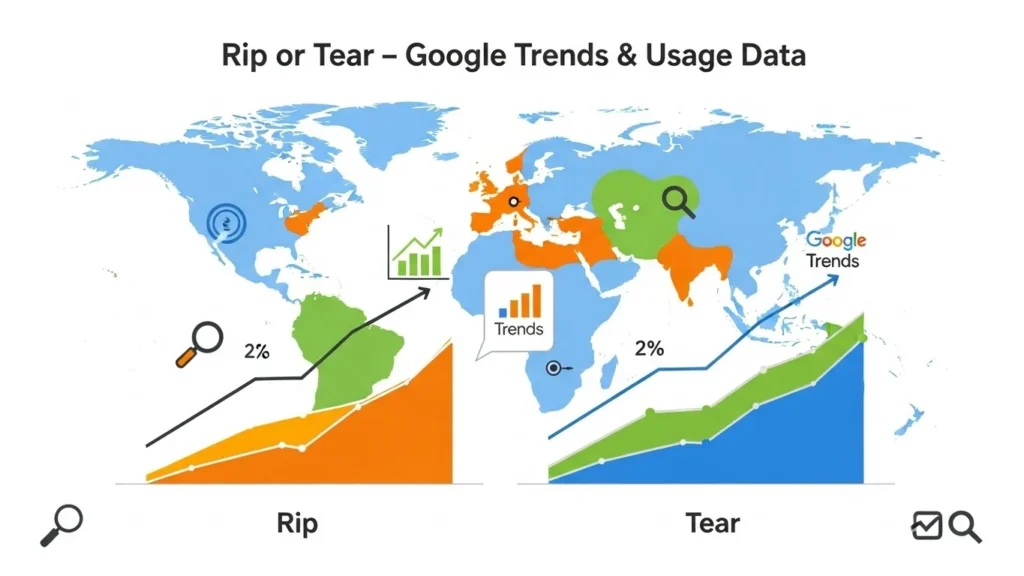
Search trends show:
- Rip is more common in casual speech searches
- Tear appears more in writing and education
- Learners often search “rip vs tear difference”
Usage patterns:
- Conversation → rip
- Writing → tear
Rip vs Tear ; Comparison Table
| Feature | Rip | Tear |
| Tone | Informal | Neutral/Formal |
| Speed | Fast | Neutral |
| Force | Strong | Implied |
| Writing use | Casual | Professional |
| Past form | Ripped | Tore / Torn |
Easy Memory Trick
- Rip = Rough and Rapid
- Tear = Technical and Traditional
FAQs ; Rip or Tear
1. Can rip and tear mean the same thing?
Yes, in many casual contexts.
2. Which is more formal?
Tear.
3. Is “ripped paper” wrong?
No, but it sounds informal.
4. What is the past tense of tear?
Tore.
5. What is the past participle of tear?
Torn.
6. Can tear be a noun?
Yes. A tear in the fabric.
7. Which should I use in exams?
Tear is safer.
Professional Writing Advice
- Choose words based on tone
- Use tear in academic or legal writing
- Use rip in dialogue or informal content
- Be consistent throughout the text
Word choice affects clarity and style.
Conclusion
The difference between rip or tear is not about correctness but about tone, force, and context. Rip is informal and emphasizes fast, forceful action. Tear is neutral and focuses on the damage itself. Both words are correct, but they are not always interchangeable.
If you are speaking casually or showing emotion, rip sounds natural. If you are writing formally or describing damage clearly, tear is the better choice. Understanding this difference improves your writing, speaking, and confidence in English.
Now you can choose between rip or tear with clarity and precision every time.

Hye ! I am Henry P. Whitmore i am English writer known for my clear and practical approach to English grammar, word usage, and language clarity. I focuses on helping learners, writers, and professionals understand confusing English terms in a simple way. My work is especially useful for people who struggle with spelling differences, word meanings, and correct usage in everyday writing