
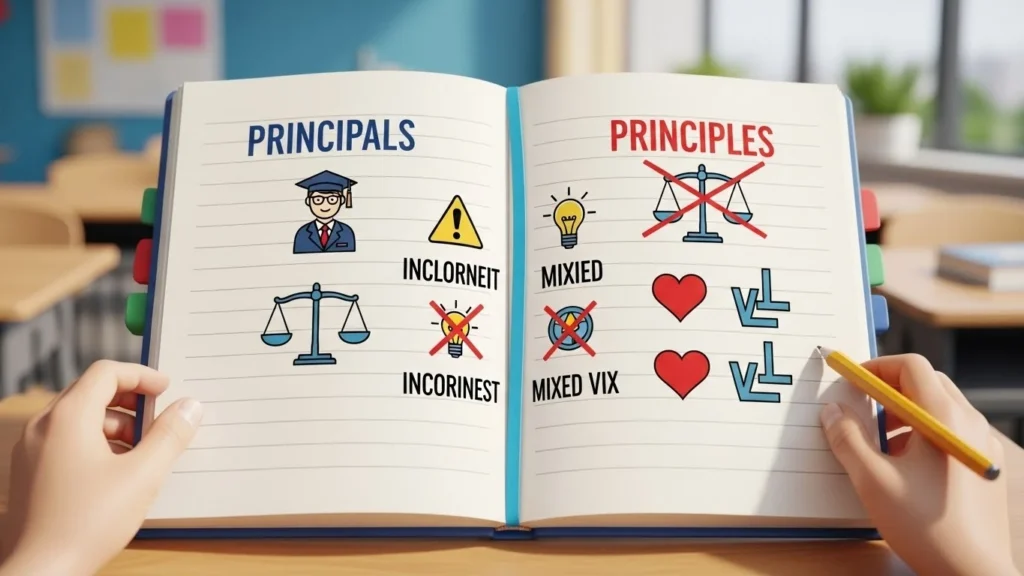
Principals refers to people or main leaders (like a school head), while principles means rules or beliefs.
English learners and writers often confuse “principals” and “principles.” Both words sound the same but have very different meanings.
Using the wrong one can change your sentence completely and make your writing look unprofessional.
Many people search for “principals or principles” because they are unsure which word to use in emails, essays, or social media.
This confusion is common because English has many words that sound alike but mean different things. Understanding the difference will help you write clearly and communicate your ideas accurately.
In this article, we will explain the difference between principals and principles, explore their origins, compare British and American usage, highlight common mistakes, and provide real-world examples.
By the end, you will confidently know which word to use in every situation.
Principals or Principles ; Quick Answer
- Principals → Refers to people in leadership positions or main figures.
- Example: The school principals attended the conference.
- Example: The school principals attended the conference.
- Principles → Refers to fundamental rules, beliefs, or morals.
- Example: Honesty is one of her core principles.
- Example: Honesty is one of her core principles.
✅ Quick Tip: Use principals for people, principles for ideas or rules.
Read more about : Parley or Parlay: Correct Usage Explained
The Origin of Principals or Principles
- Principals comes from Latin principalis, meaning first in rank or importance. It has been used in English since the 14th century to describe leaders or main figures.
- Principles comes from Latin principium, meaning beginning or foundation. It refers to basic truths, rules, or moral beliefs.
- Over time, English speakers adopted both words for different contexts, but their similar pronunciation has caused confusion.
British English vs American English Spelling
Both principals and principles are spelled the same in British and American English. The confusion is not about spelling but meaning.
| Word | British English | American English | Usage Notes |
| Principals | ✅ Correct | ✅ Correct | Refers to leaders or main figures |
| Principles | ✅ Correct | ✅ Correct | Refers to rules, beliefs, or moral truths |
Which Spelling Should You Use?
- US audience: Use principals for people, principles for rules or morals.
- UK/Commonwealth audience: Same usage rules apply.
- Global writing: Stick to these rules for clarity and professionalism.
Common Mistakes with Principals or Principles
- Using principals when referring to rules. ❌
- Wrong: She follows strong principals.
- Correct: She follows strong principles. ✅
- Wrong: She follows strong principals.
- Using principles for people. ❌
- Wrong: The principles of the school spoke at the meeting.
- Correct: The principals of the school spoke at the meeting. ✅
- Wrong: The principles of the school spoke at the meeting.
- Mixing both words in formal writing or academic essays. Always double-check the context.
Principals or Principles in Everyday Examples
Emails:
- All school principals should review the new policy.
- Our company operates on strong ethical principles.
Social Media:
- He shared his top principles for success.
- The principals of the local schools met today.
News Headlines:
- School principals discuss student safety measures.
- Principles of democracy must guide policy decisions.
Formal Writing:
- The organization’s guiding principles include fairness and transparency.
- Principals from various institutions attended the seminar.
Principals or Principles ; Google Trends & Usage Data
Analysis of Google search trends shows:
- Both words are popular, but searches often include clarifications or “difference between” queries.
- Confusion is more common among students and non-native English speakers.
| Keyword | Global Search Popularity | Notes |
| Principals | Medium | Mostly used in education and leadership contexts |
| Principles | High | Common in ethics, business, and everyday writing |
Keyword Variations Comparison Table
| Word | Correctness | Example Sentence |
| Principals | ✅ Correct | The school principals attended the meeting. |
| Principles | ✅ Correct | She follows strong principles in her work. |
FAQs
1. Can I use “principals” for rules?
No, principals refers to people, not rules or beliefs. Use principles instead.
2. Can “principles” refer to people?
No, principles only refers to rules, morals, or beliefs.
3. Are the spellings different in British and American English?
No, both are spelled the same. The difference is in meaning, not spelling.
4. How do I remember which one to use?
Think: Principals = people, Principles = rules or morals.
5. Can I use “principals” in business writing?
Yes, for leaders or main figures, e.g., The company principals approved the plan.
6. Are there any common errors?
Yes, confusing principals for rules and principles for people is the most frequent mistake.
7. Can “principles” be used in casual writing?
Yes, e.g., Honesty is one of my core principles.
Conclusion
In conclusion, principals and principles are pronounced the same but have distinct meanings.
Principals refers to people in leadership or main figures, while principles refers to rules, beliefs, or morals.
Both words are spelled the same in British and American English, so context is key.
Using the right word improves clarity, prevents misunderstandings, and makes your writing professional. Remember: principals = people, principles = rules or morals.
By applying the examples, tables, and tips in this article, you can confidently write without errors and communicate your ideas effectively.
✅ Key takeaway: Principals = leaders; Principles = rules. Use the correct word based on context to ensure clear writing.

I am an English author who loves words and their meaning. Writing is not just my work, it is my passion. I write to make English simple, clear, and easy to understand for everyone. My focus is on real language, real mistakes, and real learning. Every article I write comes from research, experience, and a love for honest writing. My goal is simple: help readers feel confident with English.