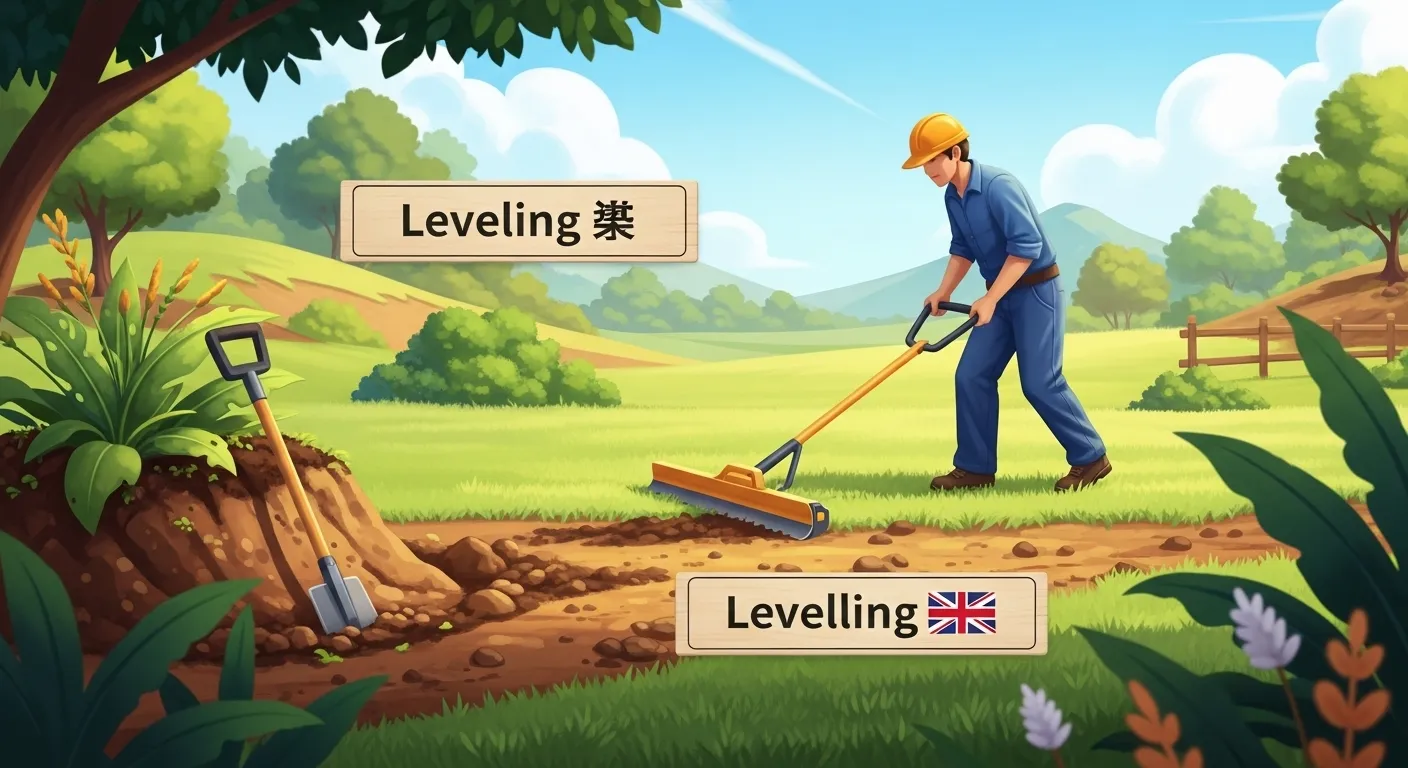
“Leveling” is the American English spelling, while “Levelling” is the British English spelling; both are correct depending on the region. ✅
Writers, students, and professionals often get confused between “leveling” and “levelling.” Both words refer to the act of making something flat, even, or balanced, but the correct spelling depends on the variety of English you are using.
Using the wrong spelling can make your writing appear inconsistent or unprofessional.
People search for “leveling or levelling” because they encounter both forms in construction, gaming, business, or writing contexts.
American English and British English differ in spelling conventions, which leads to confusion. Understanding which form to use ensures accurate communication in emails, reports, academic writing, and social media.
In this article, we will explain the correct usage of leveling/levelling, explore its origin, compare British and American English conventions, highlight common mistakes, and provide examples in everyday writing.
By the end, you will confidently know which spelling to use for your audience and context.
Leveling or Levelling ; Quick Answer
- Leveling → Correct in American English; refers to making something flat, even, or balanced.
- Example: The workers are leveling the ground for the new building.
- Example: The workers are leveling the ground for the new building.
- Levelling → Correct in British English; same meaning as leveling.
- Example: The construction team is levelling the garden terrace.
- Example: The construction team is levelling the garden terrace.
✅ Quick Tip: Use leveling for US audiences and levelling for UK or Commonwealth audiences.
The Origin of Leveling or Levelling
- The word level comes from the Latin libella, meaning a small balance, and Middle English level meaning “horizontal line.”
- Adding the suffix -ing creates the present participle, meaning “the act of making level or flat.”
- Leveling became the standard form in American English, while levelling remained in British English due to the preference for double consonants in certain words.
British English vs American English Spelling
Both words are correct depending on the variety of English used.
| Word | British English | American English | Usage Notes |
| Leveling | ❌ Not standard | ✅ Correct | US spelling for making something flat or balanced |
| Levelling | ✅ Correct | ❌ Rarely used | UK spelling for the same meaning |
Note: The meaning does not change; only the spelling differs.
Which Spelling Should You Use?
- US audience: Use leveling in emails, documents, and reports.
- UK/Commonwealth audience: Use levelling for consistent British spelling.
- Global writing: Match the spelling to the audience; use American English for international business documents and British English for UK-based content.
Common Mistakes with Leveling or Levelling
- Mixing both spellings in the same document. ❌
- Wrong: The team is leveling the ground, and levelling the terrace.
- Correct (US): The team is leveling the ground and terrace.
- Correct (UK): The team is levelling the ground and terrace. ✅
- Wrong: The team is leveling the ground, and levelling the terrace.
- Using the wrong form for the target audience.
- Confusing leveling/levelling with unrelated words like levering or loveling.
Leveling or Levelling in Everyday Examples
Emails:
- We are leveling the office floor before installing new carpets.
- Levelling the garden ensures proper drainage.
Social Media:
- Leveling up your gaming skills takes time and practice.
- Levelling the terrain made the park safer for visitors.
News Headlines:
- City council approves leveling of abandoned lots.
- Levelling of coastal areas planned to prevent flooding.
Formal Writing:
- The company invested in leveling the warehouse to meet safety standards.
- Levelling the building site reduced the risk of structural issues.
Leveling or Levelling ; Google Trends & Usage Data
Analysis of search trends shows:
- Leveling is more commonly searched in the US, construction, gaming, and business contexts.
- Levelling dominates searches in the UK and Commonwealth countries.
| Keyword | Global Search Popularity | Notes |
| Leveling | High (US) | Construction, gaming, US-based writing |
| Levelling | High (UK/Commonwealth) | UK construction, education, formal writing |
Keyword Variations Comparison Table
| Word | Correctness | Example Sentence |
| Leveling | ✅ US Correct | The crew is leveling the field before planting crops. |
| Levelling | ✅ UK Correct | The crew is levelling the field before planting crops. |
FAQs
1. Are leveling and levelling the same?
Yes, both mean “making something flat, even, or balanced.” Only the spelling differs by English variant.
2. Can leveling/levelling be used in gaming?
Yes, e.g., leveling up your character is standard gaming terminology.
3. Are there differences between British and American English?
Yes, US uses leveling, UK uses levelling.
4. How can I remember the correct spelling?
Think: US = one L (leveling), UK = double L (levelling).
5. Can leveling/levelling be used as a noun?
Yes, e.g., The leveling of the foundation took two days.
6. Is mixing both spellings in a document acceptable?
No, always stick to one form based on your audience.
7. Are there other words with similar US/UK spelling differences?
Yes, e.g., traveling/travelling, canceled/cancelled, modeling/modelling.
Conclusion
In summary, leveling and levelling are both correct spellings depending on the English variant. Leveling is used in American English, while levelling is standard in British English.
The meaning remains the same making something flat, even, or balanced.
Using the correct form ensures clarity and professionalism, whether in emails, reports, academic writing, or social media.
Always match your spelling to your audience to avoid confusion. Remember: US = leveling, UK = levelling.
By following the examples, tables, and tips in this article, you can confidently write about construction, gaming, and everyday leveling activities.
Read more about !
Inputting or Imputting: Which Spelling Is Correct? ⌨️✅

I am an English author who loves words and their meaning. Writing is not just my work, it is my passion. I write to make English simple, clear, and easy to understand for everyone. My focus is on real language, real mistakes, and real learning. Every article I write comes from research, experience, and a love for honest writing. My goal is simple: help readers feel confident with English.