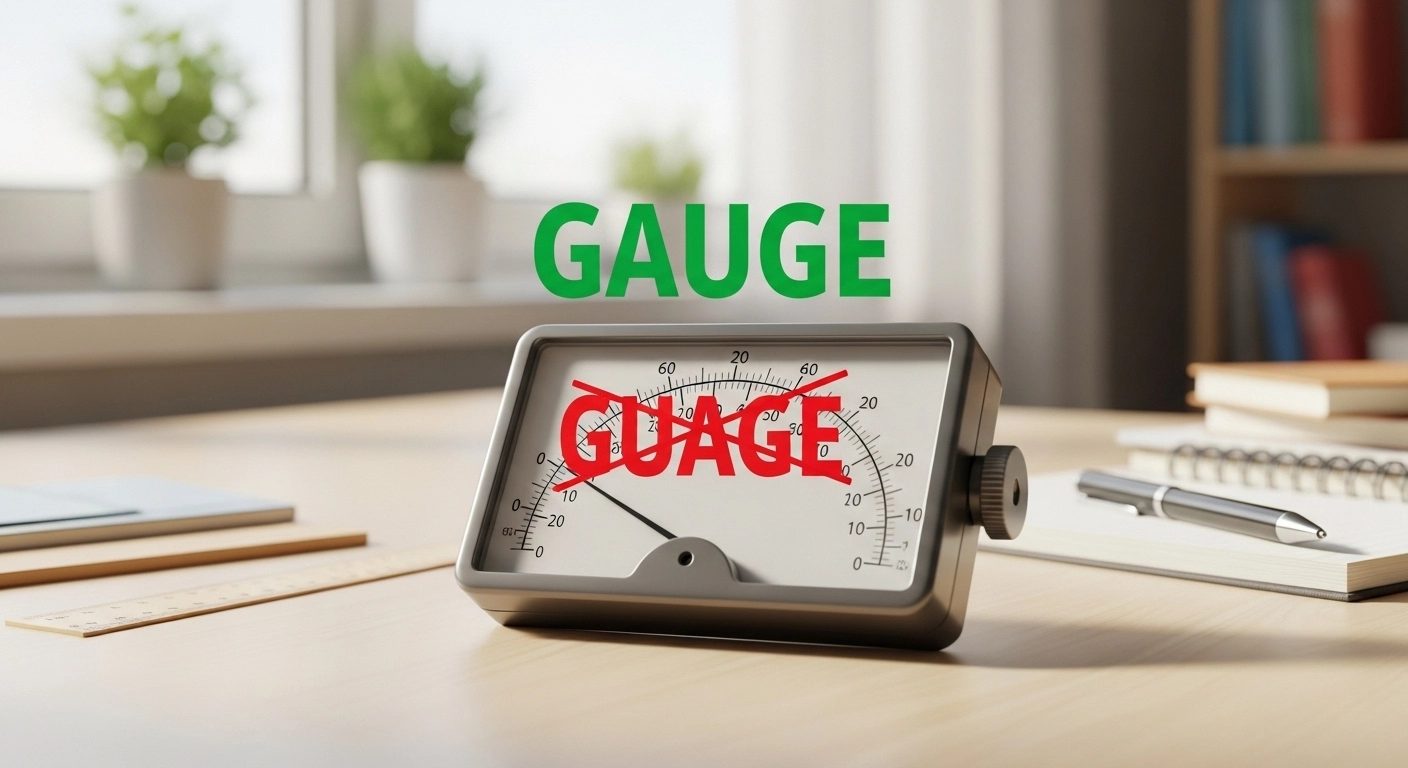
Gauge is the correct spelling, while guage is a common spelling mistake.
English learners and casual writers often get confused between “guage” and “gauge.” Both words are pronounced similarly, but only one is correct in standard English writing. Using the wrong form can make your writing appear unprofessional or cause misunderstandings.
People search for “guage or gauge” because they often hear the word in technical contexts, like measuring devices, car dashboards, or DIY projects, and they are unsure how to spell it correctly. Spelling mistakes are common because the “au” and “ua” letters are easily swapped in pronunciation. Knowing the difference ensures clarity, whether you’re writing emails, technical documents, or social media posts.
In this article, we will explain the correct usage of gauge, explore its origins, compare British and American English usage, highlight common mistakes, and provide real-life examples. By the end, you will confidently know which spelling to use in any context.
Guage or Gauge – Quick Answer
- Gauge → Correct spelling; refers to a measuring instrument, standard, or indicator.
- Example: The fuel gauge shows that the tank is full.
- Example: The fuel gauge shows that the tank is full.
- Guage → Incorrect spelling; not standard in English.
✅ Quick Tip: Always use gauge. Guage is a common misspelling.
Read mor about: Questioner vs Questionnaire: Which One Is Correct? 🤔📋
The Origin of Guage or Gauge
- Gauge comes from the Old French word jauge, meaning a standard measure or container, which entered English in the 14th century.
- Historically, it referred to measuring liquids, weights, or dimensions. Over time, the term expanded to include instruments and indicators, such as pressure gauges or fuel gauges.
- Guage has no historical origin in English and is considered a spelling error.
British English vs American English Spelling
Both British and American English use gauge as the correct spelling. The misspelling guage is not standard in any English variant.
| Word | British English | American English | Usage Notes |
| Gauge | ✅ Correct | ✅ Correct | Refers to measuring instruments, standards, or indicators |
| Guage | ❌ Incorrect | ❌ Incorrect | Common spelling error |
Which Spelling Should You Use?
- US audience: Always use gauge for technical or general writing.
- UK/Commonwealth audience: Use gauge; guage is incorrect.
- Global writing: Stick to gauge to maintain professionalism and clarity.
Common Mistakes with Guage or Gauge
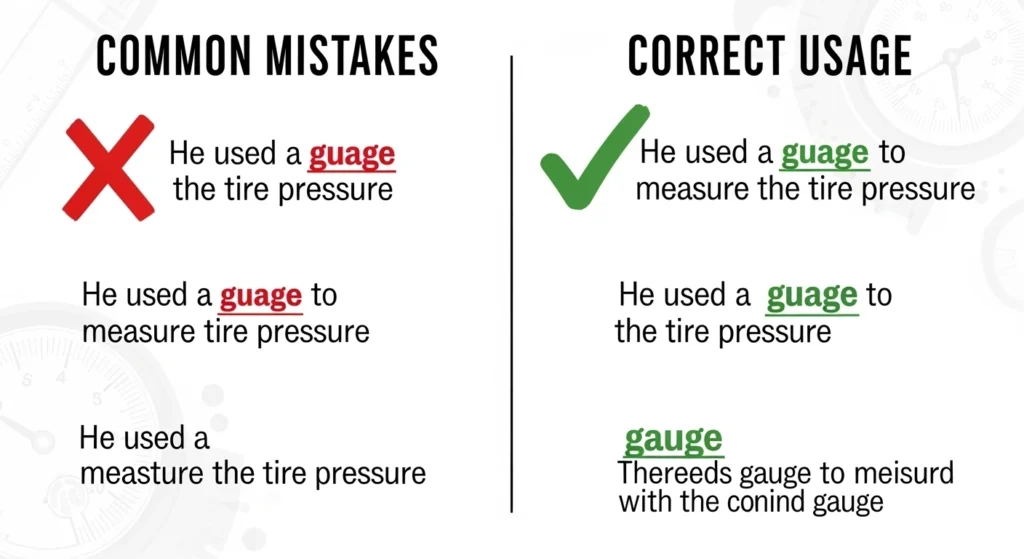
- Typing guage instead of gauge. ❌
- Wrong: Check the fuel guage before starting the car.
- Correct: Check the fuel gauge before starting the car. ✅
- Wrong: Check the fuel guage before starting the car.
- Confusing gauge with similar-sounding words like “gage” (which has separate meanings, e.g., pledge).
- Using guage in technical manuals, which can reduce credibility.
Guage or Gauge in Everyday Examples
Emails:
- Please monitor the pressure gauge during the experiment.
- Make sure the tire gauge is calibrated correctly.
Social Media:
- Check the fuel gauge before heading on a road trip!
- Using a rain gauge to track rainfall is fun and educational.
News Headlines:
- Temperature gauge readings hit record highs this summer.
- Scientists use gauges to monitor river water levels.
Formal Writing:
- The engineer adjusted the pressure gauge to the correct setting.
- Railway tracks are measured using a track gauge to ensure safety.
Guage or Gauge – Google Trends & Usage Data
Analysis of Google search trends shows:
- Gauge is consistently searched in engineering, automotive, and science contexts.
- Guage searches are usually spelling corrections or beginner English queries.
| Keyword | Global Search Popularity | Notes |
| Gauge | High | Technical, automotive, science |
| Guage | Low | Common misspelling, search for corrections |
Keyword Variations Comparison Table
| Word | Correctness | Example Sentence |
| Gauge | ✅ Correct | The fuel gauge indicates a full tank. |
| Guage | ❌ Incorrect | Check the guage before driving. (incorrect) |
FAQs
1. Is “guage” ever correct?
No, guage is always a misspelling of gauge.
2. Can “gauge” be used metaphorically?
Yes, e.g., We need to gauge customer satisfaction.
3. Are there any regional spelling differences?
No, gauge is correct in both British and American English.
4. How can I remember the correct spelling?
Think “au” in gauge like the “au” in author or automatic.
5. Can “gauge” refer to thickness or size?
Yes, e.g., The wire has a 12-gauge thickness.
6. Is “gauge” used in both nouns and verbs?
Yes, gauge can be a noun (instrument) or verb (measure, estimate).
7. Why is “guage” so common?
Because the pronunciation misleads writers; the letters are swapped by mistake.
Conclusion
In summary, gauge is the correct spelling for measuring instruments, standards, or metaphorical usage. Guage is a frequent misspelling with no valid usage in English. Both British and American English use gauge, so the key is to avoid common mistakes in writing.
Using the correct spelling improves clarity, professionalism, and credibility. Remember: gauge = measurement tool, standard, or verb, and guage = incorrect. By following the examples, tables, and tips in this article, you can confidently write emails, technical documents, social media posts, and formal reports without errors.✅ Key takeaway: Always use gauge. Avoid guage to ensure clear, professional, and accurate writing.

Hye ! I am Henry P. Whitmore i am English writer known for my clear and practical approach to English grammar, word usage, and language clarity. I focuses on helping learners, writers, and professionals understand confusing English terms in a simple way. My work is especially useful for people who struggle with spelling differences, word meanings, and correct usage in everyday writing