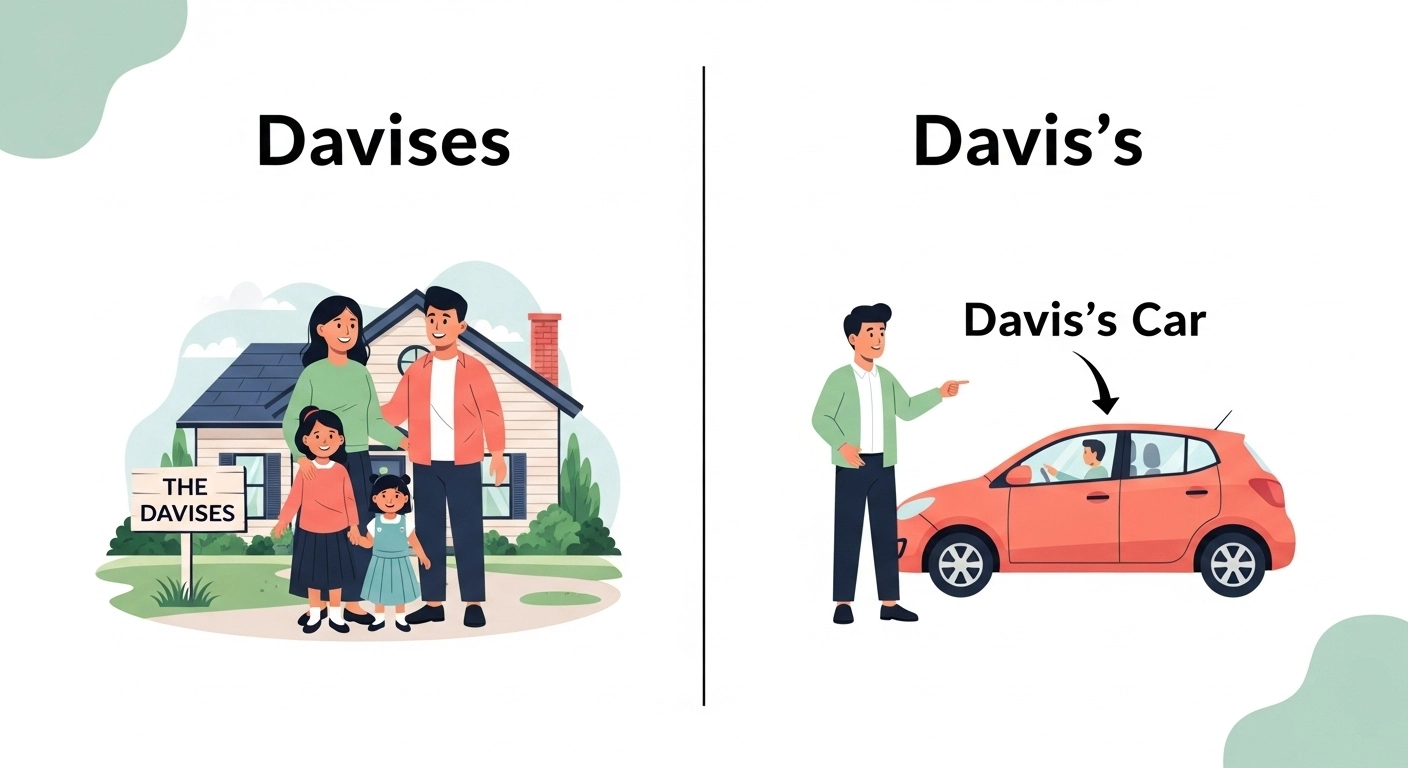
Davises is used for more than one person or a family, while Davis’s is used to show ownership by one person named Davis.
Many people search for “davises or davis’s” because English plural and possessive rules can feel confusing especially with last names that already end in -s, like Davis. You might be writing about a family, labeling ownership, creating a sign, editing formal content, or publishing text, and suddenly you pause. Should it be the Davises, Davis’s house, or the Davis’ home? All of these versions appear online, which only increases the confusion.
The real issue is that plural forms and possessive forms are different things, but they often get mixed up. Names ending in S make the rules look harder than they really are. One small apostrophe can completely change meaning and using the wrong form can look unprofessional in emails, schoolwork, signage, legal writing, and published content.
This guide explains davises or davis’s in very simple language (Hemingway Grade 3 level). You’ll get a quick answer, clear grammar rules, examples, tables, common mistakes, FAQs, and professional tips. By the end, you’ll know exactly which form to use and why.
Davises or Davis’s – Quick Answer
- Davises → ✅ Plural form (more than one person named Davis)
- Davis’s → ✅ Singular possessive (something belonging to one person named Davis)
Examples:
- The Davises live next door.
- This is Davis’s car.
👉 Plural = Davises. Possession = Davis’s.
What Do Davises and Davis’s Mean?
Davises (Plural)
Davises means more than one person with the last name Davis. This usually refers to a family or group.
- No apostrophe
- Just add -es
Example:
- The Davises are coming to dinner.
If you can replace it with they, you’re probably using the plural correctly.
Davis’s (Singular Possessive)
Davis’s shows ownership by one person named Davis.
- Apostrophe + s
- Indicates something belongs to Davis
Example:
- That is Davis’s jacket.
If you can replace it with his or her, it’s possessive.
The Origin of Davises or Davis’s
Where the Rules Come From
English grammar follows two basic rules:
- Plurals are formed by adding -s or -es
- Possessives are formed by adding ’s
Names ending in S follow the same rules as regular nouns. They are not special cases.
Why the Confusion Exists
This confusion happens because:
- Davis already ends in S
- Apostrophes are small and easy to misuse
- People mix up plural and possession
Once you separate these ideas, the rules become consistent and simple.
Read more about: Streek vs Streak: Which One Is Correct? ✅📝
British English vs American English Usage
There is a small style difference between British and American English when forming possessives.
| Form | American English | British English |
| Davis’s (possessive) | ✔ Preferred | ✔ Common |
| Davis’ (possessive) | ⚠️ Rare | ⚠️ Sometimes accepted |
| Davises (plural) | ✔ Same | ✔ Same |
👉 Davises is always the plural in both dialects.
For clarity and professionalism, Davis’s is the safest choice everywhere.
Which Form Should You Use?
Use Davises If:
- You mean a family
- You mean multiple people
- No ownership is involved
Example:
- The Davises bought a house.
Use Davis’s If:
- One person owns something
- You are showing possession
Example:
- Davis’s opinion matters.
Audience-Based Advice
- US writing → Use Davis’s for possession
- UK writing → Davis’s is safest
- Formal writing → Avoid Davis’
- content → Use the clearest form to avoid confusion
Common Mistakes with Davises or Davis’s
Mistake 1: Using an Apostrophe for Plurals
❌ The Davis’s are here.
✔ The Davises are here.
Mistake 2: Forgetting the Apostrophe for Possession
❌ That is Davis car.
✔ That is Davis’s car.
Mistake 3: Using Davis’ Without Style Guidance
❌ Davis’ book (unclear)
✔ Davis’s book
Mistake 4: Mixing Plural and Possessive
❌ The Davises’s house
✔ The Davises’ house
Plural Possessive: Davises’
Yes there is a third form, and it’s correct when used properly.
Davises’ (Plural Possessive)
- More than one Davis
- Ownership by the group
Example:
- The Davises’ home is on the corner.
Rule:
- Make it plural → Davises
- Add apostrophe → Davises’
Davises vs Davis’s vs Davises’ – Comparison Table
| Form | Meaning | Example |
| Davises | Plural | The Davises arrived. |
| Davis’s | Singular possessive | Davis’s bag. |
| Davises’ | Plural possessive | The Davises’ car. |
Davises or Davis’s in Everyday Examples
Emails
- The Davises will attend the meeting.
- Please return Davis’s file.
News Writing
- The Davises donated to charity.
- Davis’s statement was released.
Social Media
- Dinner with the Davises tonight!
- Love Davis’s new project.
Formal Writing
- Davis’s research was published.
- The Davises’ estate was sold.
Why This Rule Matters in Professional Writing
Using the wrong form:
- Looks careless
- Changes meaning
- Reduces trust
- Hurts clarity
Correct grammar builds credibility and authority.
How to Remember the Difference
Simple Trick
Ask yourself:
- More than one? → Davises
- Ownership? → Davis’s
Memory Tip
- Apostrophe = ownership
- No apostrophe = plural
Search Behavior and Usage
People search davises or davis’s when:
- Writing invitations
- Creating signs
- Editing documents
- Learning grammar rules
This confusion appears globally, especially in:
- United States
- United Kingdom
- Canada
- Australia
Correct vs Incorrect Examples
| Incorrect | Correct |
| The Davis’s family | The Davises |
| Davis car | Davis’s car |
| The Davises’s home | The Davises’ home |
| Davis’ book | Davis’s book |
FAQs
1. Is “Davises” correct?
Yes. It is the plural form.
2. Is “Davis’s” correct?
Yes. It shows singular possession.
3. Is “Davis’” acceptable?
Sometimes, but it’s not recommended.
4. How do I pluralize Davis?
Add -es → Davises.
5. How do I show family ownership?
Use Davises’.
6. Which form is best for formal writing?
Davis’s.
7. Do these rules apply to other names?
Yes (Jones → Joneses, Jones’s).
Professional Grammar Advice
- Learn plural vs possessive rules early
- Be consistent
- Follow a style guide
- Rewrite the sentence if unsure
Clear grammar equals clear meaning.
Conclusion
The confusion between davises or davis’s comes from mixing up plural and possessive forms. Once you separate these ideas, the rules become simple. Davises is the correct plural when talking about more than one person with the last name Davis. Davis’s is the correct singular possessive when one person named Davis owns something. If the whole family owns something, the correct form is Davises’.
Understanding these differences helps you write clearly, professionally, and confidently. Whether you’re writing emails, signs, articles, or legal documents, choosing the correct form shows attention to detail and strong language skills. With this guide, you can now pick the right version every time without hesitation.

Hye ! I am Henry P. Whitmore i am English writer known for my clear and practical approach to English grammar, word usage, and language clarity. I focuses on helping learners, writers, and professionals understand confusing English terms in a simple way. My work is especially useful for people who struggle with spelling differences, word meanings, and correct usage in everyday writing