Many people search for “carma or karma” because they are unsure which spelling is correct. You may have seen both words online, in social media posts, comments, emails, or even articles.
Because both spellings look similar and sound almost the same when spoken, the confusion feels natural.
This confusion is especially common for non-native English speakers, students, bloggers, and casual writers. Spellcheck tools and autocorrect also play a role. Sometimes they fail to catch the mistake. Other times, people see “carma” used by others and assume it might be correct.
The truth is simple, but the internet makes it confusing. “Karma” is a real word with a long history. It has deep roots in religion, philosophy, and modern language. “Carma,” on the other hand, is not a real word in standard English. It appears because of spelling mistakes, typing errors, or sound-based guessing.
This article clears the confusion completely. You will get a quick answer, learn where the word comes from, understand spelling rules, see real-life examples, and know exactly which spelling to use in every situation. If you want to write clearly and confidently, this guide gives you everything you need.
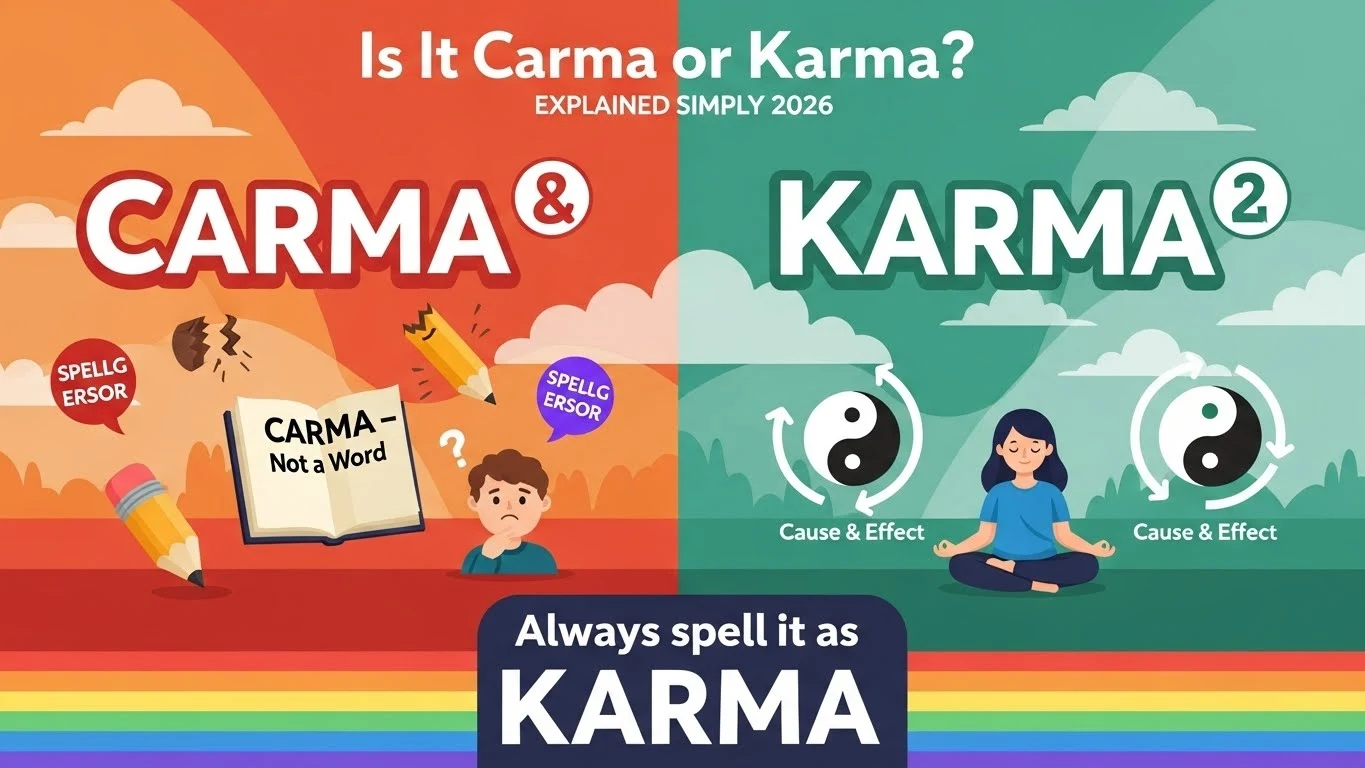
Carma or Karma – Quick Answer
Karma is the correct spelling.
Carma is incorrect in standard English.
Examples
✅ He believes good karma comes from helping others.
✅ Karma always finds its way back.
❌ He believes good carma comes from helping others.
❌ Bad carma will catch up with him.
Karma refers to actions and their results.
Carma has no accepted meaning in English.
If you remember just one thing, remember this: Always use karma.
discover more article: Difference between logical and bitwise OR in Java
The Origin of Carma or Karma

The word karma comes from the ancient Sanskrit word “karman.” It means action, work, or deed. The idea of karma is central to several ancient religions, including:
- Hinduism
- Buddhism
- Jainism
In these traditions, karma explains how actions shape future outcomes. Good actions lead to good results. Bad actions lead to bad results. This belief system has existed for thousands of years.
Over time, the word karma moved from religious texts into everyday language. Today, people use it in casual speech, writing, movies, books, and news articles. Many people use it to describe fairness, cause and effect, or moral balance.
Why “Carma” Exists
The spelling “carma” does not come from history or language rules. It exists mainly because of:
- Spelling the word as it sounds
- Typing quickly and missing a letter
- Autocorrect mistakes
- Confusion with words starting with “car”
There is no linguistic or historical basis for “carma.” It has never been a correct spelling.
British English vs American English Spelling
Some English words change spelling between American and British English. For example:
- Color (US) / Colour (UK)
- Organize (US) / Organise (UK)
However, karma is not one of those words.
There is no spelling difference between British and American English for this word.
Comparison Table
| Variant | American English | British English |
|---|---|---|
| Correct spelling | Karma | Karma |
| Incorrect spelling | Carma | Carma |
No matter where you live or who you are writing for, karma stays the same.
Which Spelling Should You Use?
The answer is always the same: use karma.
By Audience
- US audience: Karma
- UK & Commonwealth: Karma
- Global audience: Karma
- Academic or professional writing: Karma
- Casual writing or social media: Karma
Using carma can make your writing look careless or unprofessional. It may also confuse readers or reduce trust in your content.
If you want clean, correct English, there is no choice here. Karma is the only correct option.
Common Mistakes with Carma or Karma
Many people make small mistakes with this word. Here are the most common ones and how to fix them.
Mistake 1: Writing “carma” instead of “karma”
❌ Good carma will come back to you.
✔ Good karma will come back to you.
Mistake 2: Thinking “carma” is an alternative spelling
❌ Both carma and karma are fine.
✔ Only karma is correct.
Mistake 3: Incorrect capitalization
❌ Karma Is Real.
✔ Karma is real.
Capitalize karma only at the beginning of a sentence or in a title.
Mistake 4: Using joke spelling in serious writing
Slang spellings may be used jokingly online, but avoid them in:
- Emails
- Articles
- Essays
- Business writing
The Origin of Carma or Karma
Emails
Thank you for your help. Good karma always comes back.
News Articles
Many believe the leader faced karma for past actions.
Social Media
Spread kindness. Karma is real.
Casual Conversation
Don’t worry. Karma will handle it.
Formal Writing
The concept of karma influences moral behavior and ethical choices.
In every situation, karma is the correct and natural choice.
Carma or Karma – Google Trends & Usage Data
Search data shows that karma is widely searched around the world. It appears in many contexts, including:
- Spiritual discussions
- Daily conversation
- Self-help content
- Movies and pop culture
The word “carma” also appears in searches, but mostly for one reason:
👉 People want to know if it is wrong.
Search Insights
- High-usage countries:
- United States
- United Kingdom
- India
- Australia
- Search intent:
- Educational
- Spelling confirmation
- Meaning and usage
Keyword Comparison Table
| Term | Correct | Meaning | Usage |
|---|---|---|---|
| Karma | ✅ Yes | Action and consequence | All contexts |
| Carma | ❌ No | None | Spelling error |
This table makes it clear: karma wins every time.
FAQs
1. Is “carma” ever correct?
No. Carma is never correct in standard English.
2. Why do people spell karma as carma?
Because of pronunciation, typing mistakes, and confusion with similar-sounding words.
3. Does karma mean fate?
Not exactly. Karma is about actions and results, not fixed destiny.
4. Is karma a religious word?
Yes, it comes from religion, but it is widely used in modern everyday language.
5. Can karma be used casually?
Yes. It is very common in casual speech, social media, and informal writing.
6. Should karma be capitalized?
Only at the beginning of a sentence or in titles.
7. Is karma in English dictionaries?
Conclusion
The confusion between carma or karma is very common, but the answer is clear and simple. Karma is the correct and only accepted spelling in English. It comes from ancient traditions and carries a strong meaning related to actions and their outcomes. Carma has no meaning and should be avoided in all types of writing.
There is no difference between American and British English spelling, so you never need to change it based on region. Whether you are writing an email, posting online, or creating professional content, using karma shows accuracy, confidence, and strong language skills.
Understanding this small spelling rule can improve your writing more than you might expect. It helps you avoid common mistakes and communicate clearly. When you are unsure, remember this simple rule: If you mean action and consequence, the word is karma. Always.

I am an English author who loves words and their meaning. Writing is not just my work, it is my passion. I write to make English simple, clear, and easy to understand for everyone. My focus is on real language, real mistakes, and real learning. Every article I write comes from research, experience, and a love for honest writing. My goal is simple: help readers feel confident with English.