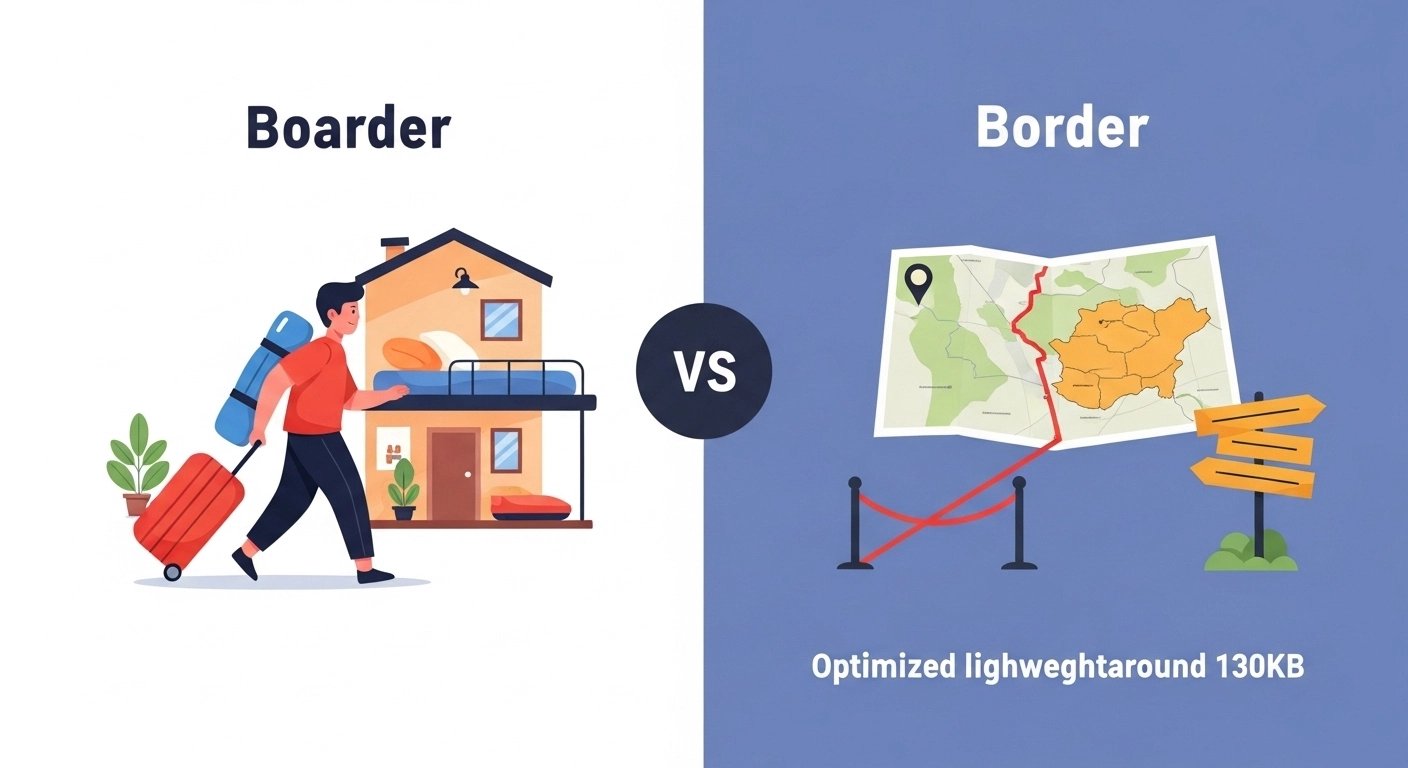
✅ Quick Tip: Use boarder for people staying in a boarding arrangement, and border for boundaries or edges.
English learners and writers often get confused between “boarder” and “border.” Both words sound similar but have completely different meanings. Using the wrong word can change the meaning of your sentence, create confusion, and appear unprofessional.
People search for “boarder or border” because they hear the words in conversation, see them online, or read them in texts. Non-native speakers and even native writers sometimes mix them up, especially in writing about travel, property, or social contexts.
Knowing the difference ensures clear communication in emails, documents, news articles, and social media posts.
In this article, we will explain the difference between boarder and border, explore their origins, compare British and American English usage, highlight common mistakes, and provide examples in everyday writing. By the end, you will confidently know which spelling to use in any context.
Read more about: Hilight or Highlight: Which Spelling Is Correct?
Boarder or Border – Quick Answer
- Boarder → Refers to a person who rents a room in someone’s house, typically with meals included.
- Example: The boarding school has thirty boarders this year.
- Example: The boarding school has thirty boarders this year.
- Border → Refers to the edge or boundary of a place, country, or object.
- Example: The United States shares a border with Canada.
- Example: The United States shares a border with Canada.
The Origin of Boarder or Border
- Boarder comes from the word board, referring to meals provided with lodging. It has been used since the 16th century to describe someone paying for lodging and meals.
- Border comes from the Old French bordure, meaning “edge” or “boundary,” and has been in English since the 13th century.
- Both words are pronounced similarly, which causes confusion, but their meanings are distinct.
British English vs American English Spelling
Both words are spelled the same in British and American English. The confusion is meaning-based, not spelling-based.
| Word | British English | American English | Usage Notes |
| Boarder | ✅ Correct | ✅ Correct | A person who pays for lodging and meals |
| Border | ✅ Correct | ✅ Correct | A boundary, edge, or dividing line |
Which Spelling Should You Use?
- US audience: Use boarder for people staying in boarding arrangements, border for boundaries.
- UK/Commonwealth audience: The same rules apply.
- Global writing: Ensure context makes your meaning clear—boarder for people, border for edges or boundaries.
Common Mistakes with Boarder or Border
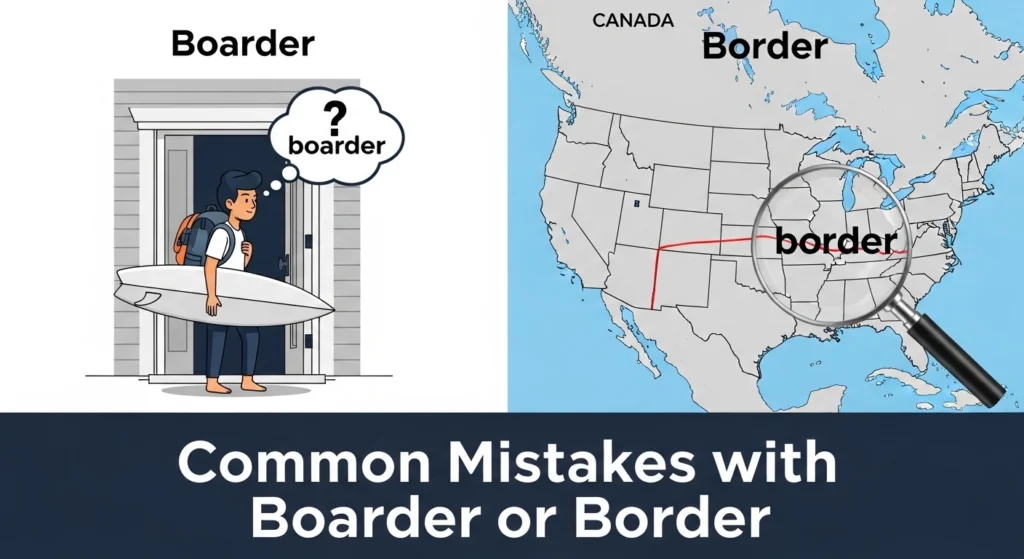
- Using border when referring to a person staying at a boarding house. ❌
- Wrong: The border at the school is very friendly.
- Correct: The boarder at the school is very friendly. ✅
- Wrong: The border at the school is very friendly.
- Using boarder when referring to an edge or country boundary. ❌
- Wrong: The boarder between France and Germany is long.
- Correct: The border between France and Germany is long. ✅
- Wrong: The boarder between France and Germany is long.
- Confusing spelling in emails, essays, or reports, which can change meaning entirely.
Boarder or Border in Everyday Examples
Emails:
- We have five new boarders joining the hostel this month.
- Please check the border of the document for formatting errors.
Social Media:
- Our guest house has welcoming boarders from all over the world.
- The country celebrated a festival at the border town.
News Headlines:
- Boarders at the school celebrated the festival together.
- Border security increased at the northern boundary.
Formal Writing:
- The boarding house accommodates both full-time and part-time boarders.
- The treaty defined the international border clearly.
Boarder or Border – Google Trends & Usage Data
Analysis of search trends shows:
- Border is more commonly searched due to discussions about countries, maps, and edges.
- Boarder searches are mainly about boarding schools, hostels, or lodging.
| Keyword | Global Search Popularity | Notes |
| Boarder | Medium | Boarding schools, hostels, lodging context |
| Border | High | Country boundaries, edges, maps, and security |
Keyword Variations Comparison Table
| Word | Correctness | Example Sentence |
| Boarder | ✅ Correct | The school has thirty boarders this year. |
| Border | ✅ Correct | The fence marks the border of the property. |
FAQs
1. Are boarder and border the same?
No, boarder is a person staying in a boarding house, while border is a boundary or edge.
2. Can “border” refer to decorative edges?
Yes, e.g., The page has a gold border.
3. Can “boarder” be used in sports?
Yes, it can refer to someone who snowboards or surfs, but context is important.
4. Are there spelling differences between British and American English?
No, both words are spelled the same; the difference is in meaning.
5. How can I remember the difference?
Think: Boarder = someone who pays for board (meals + lodging), Border = boundary.
6. Can boarder be pluralized?
Yes, e.g., The hostel accommodates ten boarders.
7. Can border refer to a political boundary?
Yes, e.g., The treaty defined the border between the two countries.
Conclusion
In summary, boarder and border are two distinct words with different meanings but similar pronunciation. Boarder refers to a person paying for lodging and meals, while border refers to an edge, boundary, or dividing line. Confusing the two can alter your sentence meaning and reduce professionalism.
Both words are spelled the same in British and American English. Choosing the correct word ensures clear, professional, and accurate communication. Remember: boarder = person, border = boundary or edge. By applying these rules and examples, you can confidently write emails, reports, social media posts, and formal documents without mistakes.✅ Key takeaway: Use boarder for people staying at a boarding house and border for boundaries or edges to avoid confusion.

I am James Whitmore. I love clear and honest English. I write to make hard words feel simple. My goal is to help readers write with confidence, without fear or confusion.