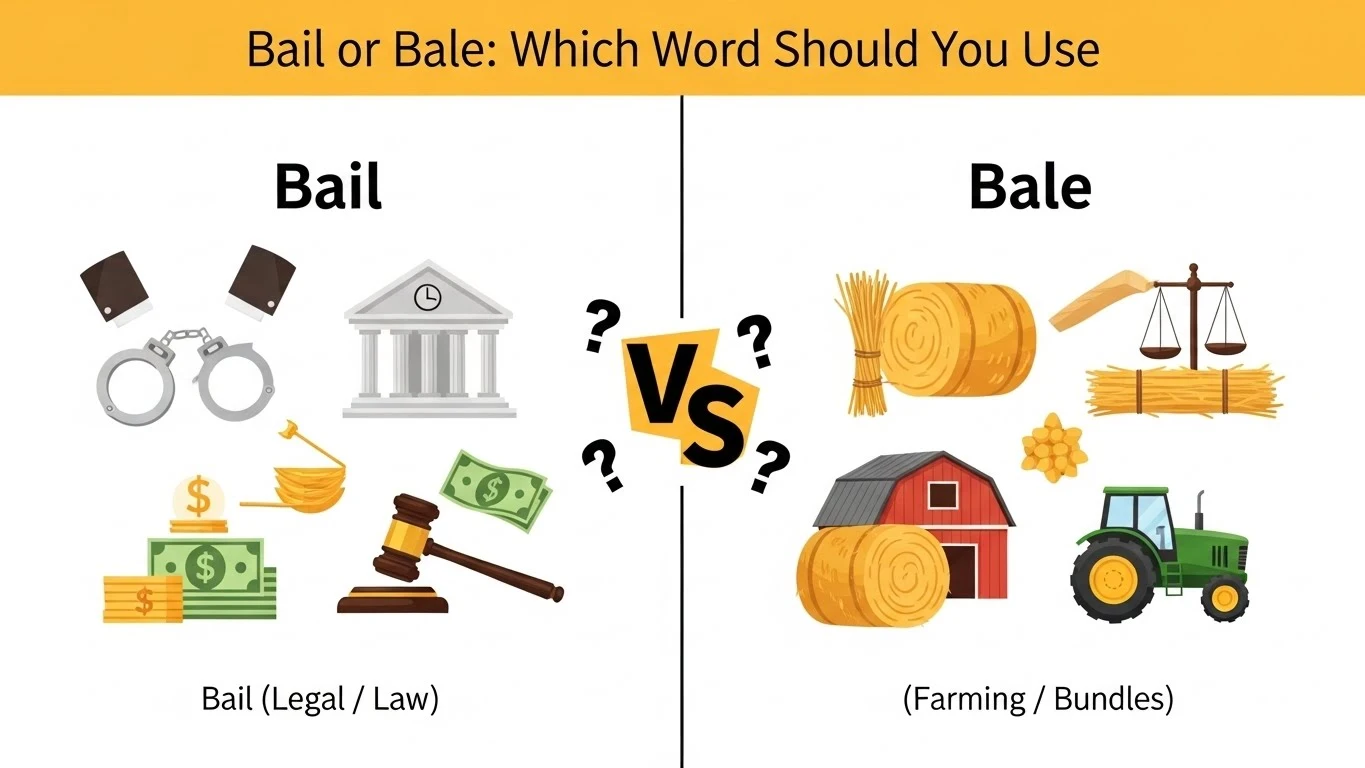
Many people search for “bail or bale” because these two words sound exactly the same but mean very different things.
You may see sentences like “He posted bail” and “A bale of hay” and wonder how one sound can have two meanings. This confusion is common for English learners, students, writers, and even native speakers.
The problem happens because bail and bale are homophones. That means they are pronounced the same but spelled differently and used in different situations.
Using the wrong one can completely change the meaning of a sentence. In legal, farming, or business writing, the mistake can look serious or unprofessional.
This article solves that confusion clearly. You’ll get a quick answer, simple definitions, origins, spelling rules, examples, common mistakes, comparison tables, FAQs, and professional advice. Everything is written in simple, clear language (Hemingway Grade 3 level).
By the end, you will always know when to use bail and when to use bale with confidence.
Bail or Bale ; Quick Answer
- Bail → Money, release, or escape
- Bale → A large bundle of goods
Examples:
- He paid bail to leave jail.
- The farmer stacked a bale of hay.
👉 Bail = legal or action-related
👉 Bale = physical object
What Does “Bail” Mean?
Simple Definition
Bail has two main meanings:
- Money paid so someone can leave jail
- To leave or escape a situation
Bail in Legal Use
In law, bail is money paid to the court to release someone from jail while they wait for trial.
Examples:
- She was released on bail.
- The judge set bail at $5,000.
Bail as a Verb (Leave Quickly)
Bail can also mean to leave suddenly.
Examples:
- Let’s bail early.
- He bailed on the meeting.
This use is informal but very common.
Read more about : HRV or CRV: Which One Should You Choose
What Does “Bale” Mean?
Simple Definition
A bale is a large, tightly packed bundle of goods.
Common items in bales:
- Hay
- Straw
- Cotton
- Paper
- Wool
Examples of Bale
- A bale of hay
- Cotton bales were shipped overseas.
- The farmer lifted a heavy bale.
Bale is always a noun related to physical objects.
The Origin of Bail or Bale
Origin of Bail
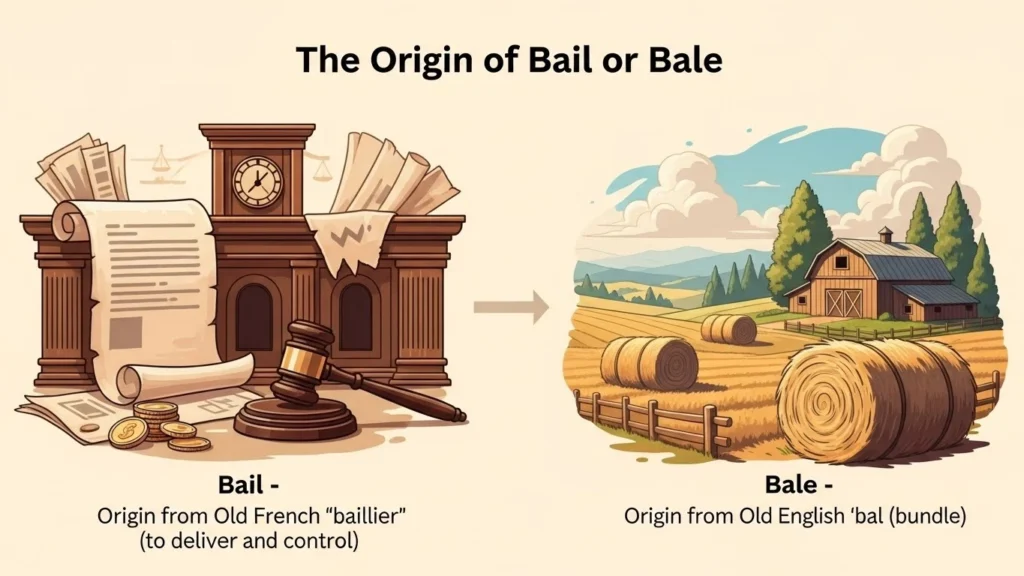
Bail comes from Old French baillier, meaning to deliver or control. It later became a legal term connected to custody and release.
Origin of Bale
Bale comes from Old English bǣl, meaning bundle or package.
Why Confusion Exists
The confusion exists because:
- They sound the same
- English spelling is inconsistent
- Both are short, common words
But their meanings come from completely different origins.
British English vs American English Spelling
There is no spelling difference between British and American English.
| Word | British English | American English |
| Bail | ✔ Same | ✔ Same |
| Bale | ✔ Same | ✔ Same |
The rules are universal.
Which Word Should You Use?
Use Bail If:
- You are talking about jail or law
- You mean leaving quickly
- You mean avoiding responsibility
Examples:
- He posted bail.
- I’m going to bail.
Use Bale If:
- You are talking about farming
- You mean bundled goods
- You can count or stack it
Examples:
- A bale of hay
- Paper bales
Audience-Based Advice
- US audience → Same rules
- UK/Commonwealth → Same rules
- Global audience → Context decides meaning
Bail or Bale in Verb Forms
| Word | Verb Form | Example |
| Bail | Bail / Bailed | He bailed out. |
| Bale | Bale / Baled | They baled the hay. |
Common Mistakes with Bail or Bale
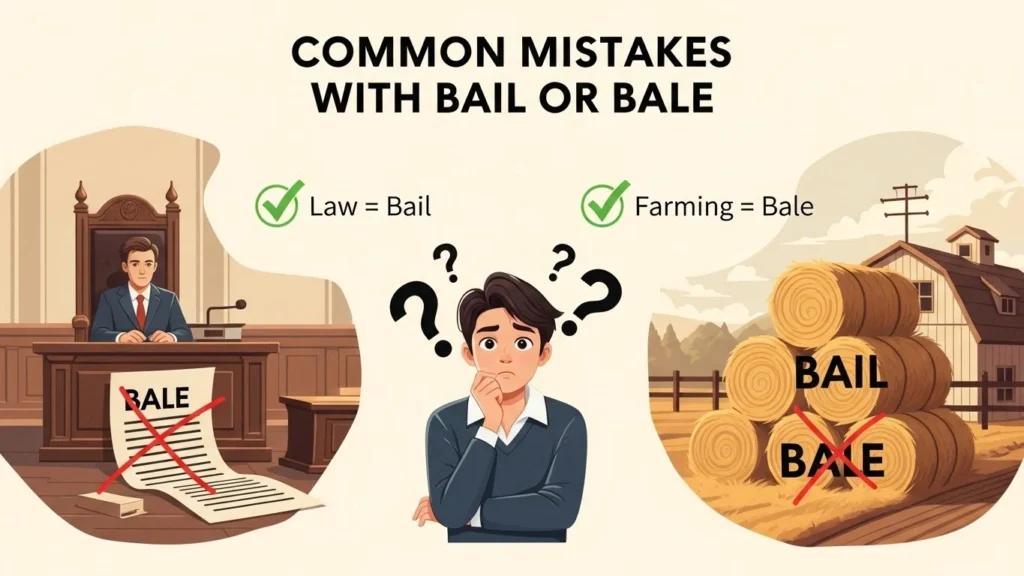
Mistake 1: Using bale for jail
❌ He paid bale.
✔ He paid bail.
Mistake 2: Using bail for farming
❌ A bail of hay
✔ A bale of hay
Mistake 3: Guessing based on sound
❌ Writing what you hear
✔ Thinking about meaning first
Bail or Bale in Everyday Examples
Emails
- He couldn’t afford bail.
- We loaded the bale onto the truck.
News
- The suspect was released on bail.
- Farmers lost hay bales in the storm.
Social Media
- Let’s bail 😅
- So many hay bales today 🌾
Formal Writing
- Bail conditions were strict.
- Cotton bales were exported.
Bail or Bale ; Google Trends & Usage Data
Search trends show:
- Bail is searched more in legal and news contexts
- Bale is searched in farming and logistics contexts
- “Bail or bale” is common among learners
The intent is usually meaning clarification.
Bail vs Bale ; Comparison Table
| Feature | Bail | Bale |
| Meaning | Release or escape | Bundled goods |
| Part of speech | Noun & verb | Noun & verb |
| Legal use | ✔ Yes | ❌ No |
| Farming use | ❌ No | ✔ Yes |
| Informal use | ✔ Yes | ❌ No |
Easy Memory Trick
- Bail → Think jail (same letters)
- Bale → Think hay bale
One letter changes everything.
FAQs
1. Are bail and bale interchangeable?
No. They mean completely different things.
2. Is “bale out” correct?
No. It should be bail out.
3. Can bale be a verb?
Yes. They baled the hay.
4. Can bail be informal?
Yes. Let’s bail.
5. Is bail always legal?
No. It can also mean leaving.
6. Is bale ever used for money?
No. Never.
7. Which is more common?
Bail appears more in everyday speech.
Professional Writing Advice
- Always check context
- Never rely on pronunciation alone
- Use bail in legal or action contexts
- Use bale for physical bundles
Correct word choice improves clarity and trust.
Conclusion
The difference between bail or bale is clear once you focus on meaning. Bail relates to law, money, or leaving a situation. Bale refers to a large, bundled object like hey or cotton. They sound the same, but they are never interchangeable.
If you remember just one thing, remember this:
👉 Jail → Bail
👉 Hay → Bale
With that simple rule, you can avoid mistakes and write with confidence in any situation.

Hye ! I am Henry P. Whitmore i am English writer known for my clear and practical approach to English grammar, word usage, and language clarity. I focuses on helping learners, writers, and professionals understand confusing English terms in a simple way. My work is especially useful for people who struggle with spelling differences, word meanings, and correct usage in everyday writing