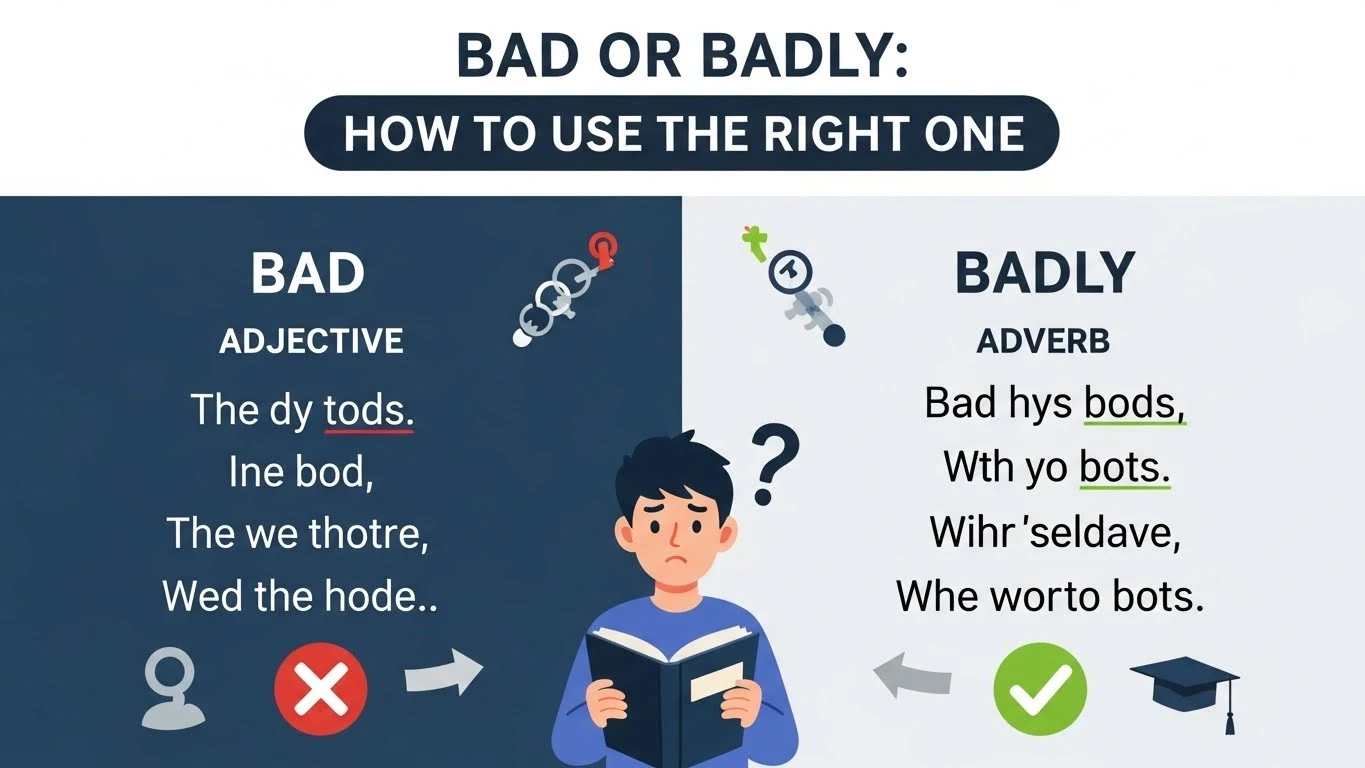
Many people search for “bad or badly” because these two small words cause big confusion. You may hear someone say, “I feel badly,” and wonder if that is correct.
You may write, “She did bad on the test,” and then doubt yourself. Spellcheck often stays silent, even when the sentence sounds wrong.
The problem is grammar, not spelling. Bad and badly look related, but they play different roles in a sentence. One is an adjective.
The other is an adverb. Mixing them up can change the meaning or make your writing sound careless. This matters in school, at work, and in professional writing.
This article solves that confusion. It gives a quick answer first. Then it explains the origin of the words, how English rules apply, and how usage works in British and American English. You will also see common mistakes, clear examples, trend insights, and FAQs. By the end, you will know exactly when to use bad or badly and why.
Bad or Badly ; Quick Answer
“Bad” is an adjective.
“Badly” is an adverb.
Examples:
- “The movie was bad.”
- “She performed badly.”
Use bad to describe a noun or how someone feels.
Use badly to describe an action.
The Origin of Bad or Badly
Origin of “Bad”
The word bad comes from Old English. Its exact origin is unclear, but it has long meant poor quality, harmful, or unpleasant. It is one of the most common adjectives in English.
Origin of “Badly”
Badly comes from bad plus the adverb ending ly. This ending turns adjectives into adverbs. It shows how an action is done.
Why Confusion Exists
- Both words share the same root.
- Spoken English often bends grammar rules.
- Some expressions sound natural but break strict rules.
The confusion is about grammar function, not spelling.
More to read about: Confused between lien and levy? This guide makes it clear 2026
British English vs American English Spelling
There is no spelling difference between British and American English for bad or badly.
Both dialects spell and use these words the same way.
Comparison Table
| Word | American English | British English |
| Bad | Bad | Bad |
| Badly | Badly | Badly |
| Meaning | Same | Same |
| Rule | Same | Same |
Any difference you hear is about style, not spelling.
Which Spelling Should You Use?
The choice depends on sentence structure, not audience.
Use “Bad” When:
- Describing a noun
- Talking about feelings
- Following linking verbs like feel, seem, be
Examples:
- “That was a bad idea.”
- “I feel bad about it.”
Use “Badly” When:
- Describing an action
- Answering “how?”
Examples:
- “He sings badly.”
- “The plan failed badly.”
Audience Based Advice
- US audience: Grammar rules apply the same.
- UK/Commonwealth: Same usage.
- Global audience: Clear grammar improves understanding.
Common Mistakes with Bad or Badly
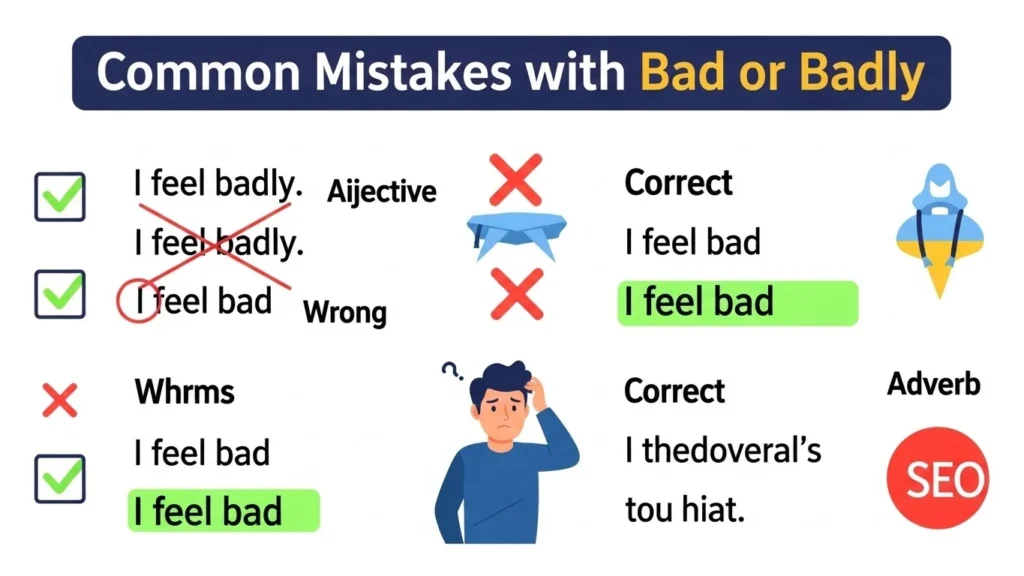
Mistake 1: “I Feel Badly”
This suggests poor ability to feel, not emotion.
Correct:
- “I feel bad.”
Mistake 2: “She Did Bad on the Test”
Here, you describe performance, not a thing.
Correct:
- “She did badly on the test.”
Mistake 3: Overthinking Informal Speech
Casual speech breaks rules, but writing should not.
Mistake 4: Ignoring Linking Verbs
Linking verbs take adjectives, not adverbs.
Bad or Badly in Everyday Examples
Emails
“I feel bad about the delay.”
News Writing
“The company performed badly during the quarter.”
Social Media
“That game went bad.”
“I played badly today.”
Formal Writing
“The policy had a bad outcome.”
“The system responded badly to stress.”
Bad or Badly ; Google Trends & Usage Data
Search interest in “bad or badly” stays strong year round.
Why People Search
- Grammar homework
- Writing emails
- Editing content
- ESL learning
Regional Trends
- High searches in the US and UK
- Strong interest in English learning regions
Most searches aim to avoid mistakes, not learn spelling.
Bad vs Badly Comparison Table
| Word | Part of Speech | Used For | Example |
| Bad | Adjective | Nouns, feelings | “A bad result” |
| Badly | Adverb | Actions | “Performed badly” |
| Poor | Adjective | Quality | “Poor work” |
| Poorly | Adverb | Manner/health | “Slept poorly” |
FAQs
1. Is “I feel badly” ever correct?
Only if you mean physical inability to feel.
2. Why do people say “do bad”?
It is informal speech, not formal grammar.
3. Can “bad” be an adverb?
In casual speech, yes. In formal writing, no.
4. Are rules the same in British English?
Yes. No difference.
5. What is the easiest rule to remember?
Actions use badly. Feelings use bad.
6. Does spellcheck catch this error?
Usually not.
7. Is this a common ESL mistake?
Yes, very common.
Conclusion
The confusion between bad or badly comes from how English mixes sound and grammar. The key difference is simple. Bad is an adjective. Badly is an adverb. One describes things or feelings. The other describes actions.
There is no spelling difference between British and American English. The rules stay the same everywhere. What changes is how carefully people follow them, especially in speech. In writing, choosing the right word shows clarity and care.
When you talk about how something feels or what something is, use bad. When you talk about how something is done, use badly. Remembering this rule helps you write better emails, stronger essays, and clearer professional content.
Small words matter. Now you know how to use bad or badly the right way every time.

I am an English author who loves words and their meaning. Writing is not just my work, it is my passion. I write to make English simple, clear, and easy to understand for everyone. My focus is on real language, real mistakes, and real learning. Every article I write comes from research, experience, and a love for honest writing. My goal is simple: help readers feel confident with English.